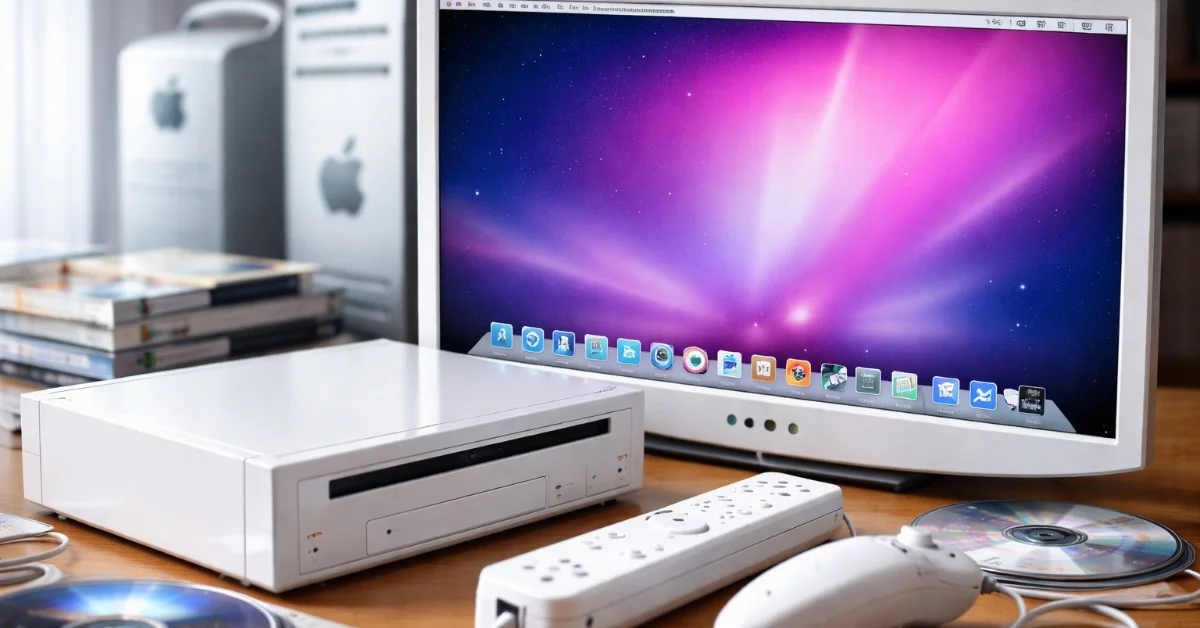
Developer Bryan Keller has published a detailed account of getting Mac OS X 10.0 Cheetah running on a Nintendo Wii, turning a 2006 game console into an unlikely host for Apple’s early desktop operating system. The project attracted attention on Hacker News and in retro-computing circles because it is not a simple emulator demo. Keller describes building a boot path, patching low-level software and writing or adapting drivers so the Wii could behave enough like a PowerPC Mac to boot the system.
Why the Wii made the project plausible
The technical link is the PowerPC architecture. Keller notes that the Wii uses a PowerPC 750CL processor, related to the PowerPC chips used in some G3-era Macs. That did not make the port easy, but it gave the project a more realistic starting point than a completely unrelated platform. The Wii’s memory layout, device tree, framebuffer, USB stack and storage path still required substantial work.
In the write-up, Keller explains that the process involved a custom bootloader, kernel patching, debugging through limited output and handling driver problems that were never part of Apple’s supported hardware plan. The associated GitHub repository, wiiMac, describes itself as a Mac OS X bootloader for the Nintendo Wii and lists Mac OS X 10.0 Cheetah as the supported version, with later versions still unsupported.
Useful, but not a normal Mac replacement
The project is best understood as an impressive proof of technical persistence rather than a practical way to run a daily computer. The repository lists several limitations, including no Wi-Fi, Bluetooth, optical drive, hardware-accelerated graphics or audio support. Those limits are expected for a project that has to bridge a consumer game console and an operating system designed for Apple’s own computers.
Even with those constraints, the work is meaningful because it shows how much of an operating system port depends on the unglamorous pieces: boot arguments, memory mappings, driver assumptions, input devices and video output. The most interesting part is not only that a Mac OS X screen can appear on a Wii, but that the path to get there has been documented in enough detail for other low-level developers to study.
Why it spread beyond hobbyist circles
The story travelled because it combines nostalgia, hardware hacking and a clear technical challenge. The Wii is familiar to a broad audience, while Mac OS X Cheetah represents an early era of Apple’s modern operating system. Running one on the other creates the kind of improbable pairing that retro-computing communities enjoy, but the post also gives serious readers a look at kernel work, driver compatibility and PowerPC-era assumptions.
There is still a verification boundary to respect. Novara News has not independently reproduced the setup, and the strongest evidence comes from Keller’s own documentation, repository and community discussion around the project. That is why the safest framing is not that the Wii has become a fully supported Mac, but that a developer has documented a working port path for Mac OS X 10.0 Cheetah on Nintendo’s console. For a hobby project, that is already a substantial achievement.