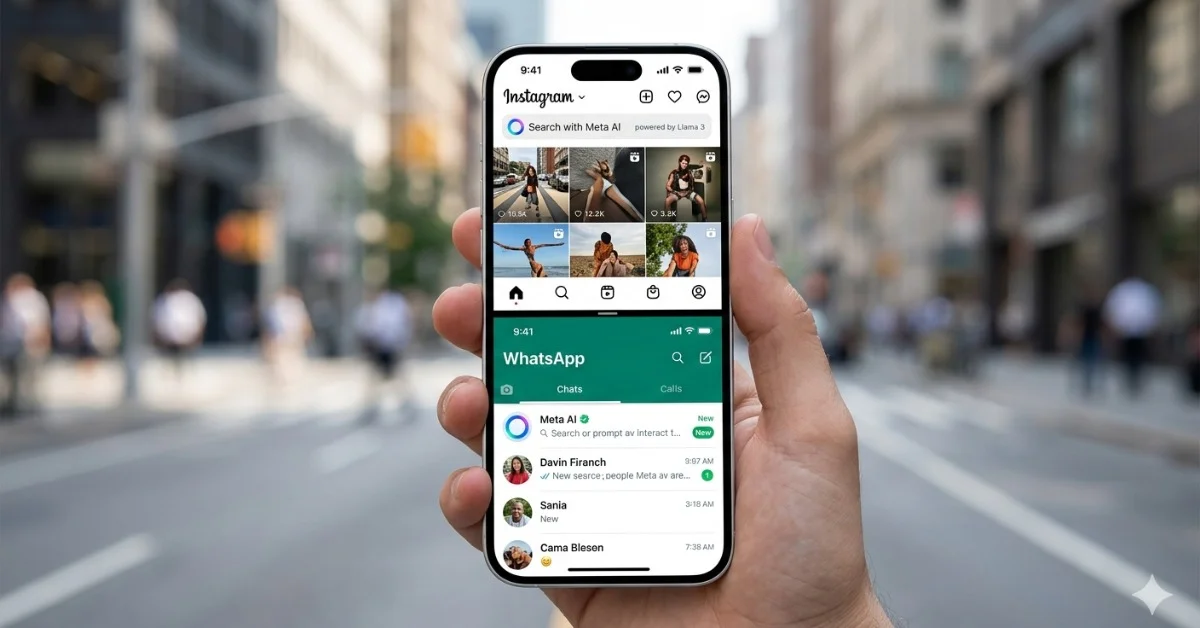
Meta's Llama 3 rollout was one of the clearest examples of AI becoming part of everyday social apps. In April 2024, Meta introduced Llama 3 and expanded Meta AI across Facebook, Instagram, WhatsApp and Messenger. The assistant appeared in feeds, chats, search surfaces and a standalone web experience, giving users a way to ask questions, create images and get real-time information without leaving Meta's apps.
The important part was placement. Meta did not ask most users to download a separate AI product. It inserted Meta AI into services that already had billions of users. That made the rollout feel different from a traditional chatbot launch. For some users, AI suddenly appeared inside the search bar or chat interface they already used every day.
Search became an AI entry point
Meta's own announcement said Meta AI would be available in search across Facebook, Instagram, WhatsApp and Messenger, with access to real-time information from the web. It also described Meta AI in Facebook feed, where users could ask follow-up questions about posts. Image generation through Imagine became faster, with images appearing as the user typed. These features showed Meta's plan clearly: put AI inside the actions users already perform in its apps.
That design also created friction. Business Insider described the experience as unusual because users normally expect social search bars to find people, pages, groups, locations or hashtags, not open a general-purpose chatbot. AP later noted that users could not fully turn Meta AI off, though some workarounds existed. Those reactions show the tradeoff. Built-in AI is easy to discover, but it can also feel intrusive when it appears in familiar spaces.
Llama 3 was a product move, not only a model release
Llama 3 mattered as an open model family, but Meta's consumer rollout was just as important. The company made the model power an assistant inside its biggest apps, then used those apps to normalize AI interactions. That gave Meta a distribution advantage over standalone AI services. If users can ask questions in WhatsApp or Instagram, Meta does not need to convince them to open another app first.
The rollout also helped set the stage for later Meta AI features. Meta now describes its assistant as able to provide local recommendations, visual understanding, shopping help and answers rooted in public posts from Instagram, Facebook and Threads. The same product logic is still visible: combine social data, existing app surfaces and AI responses in one place.
The Llama 3 rollout therefore should not be framed as a brand-new 2026 launch. It was a 2024 turning point whose effects are still visible. Meta put a capable assistant inside the places where people already search, message and browse. Whether users find that helpful or annoying depends on execution, controls and trust.