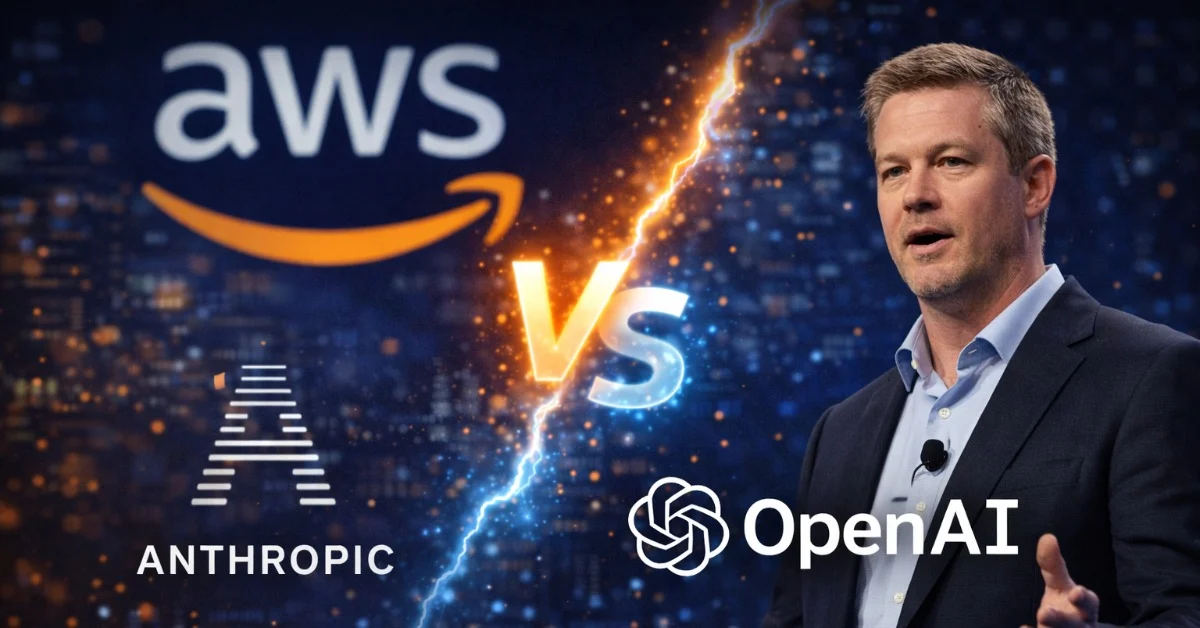
AWS CEO Matt Garman has defended Amazon’s decision to build deep commercial and investment relationships with both OpenAI and Anthropic, two of the most visible rivals in frontier AI. The comments, reported by TechCrunch on April 8, 2026, came after Amazon announced a $50 billion strategic partnership with OpenAI while already maintaining a major relationship with Anthropic.
Garman’s argument is that AWS is used to operating in a world where partners can also be competitors. Cloud providers host software companies that compete with their own products, sell infrastructure to companies that may later build rival services, and manage customer relationships across overlapping markets. In that sense, AWS sees the OpenAI-Anthropic tension as an extension of its existing “coopetition” model, not a unique conflict.
The OpenAI deal changed the optics
Amazon and OpenAI announced their multi-year strategic partnership in February 2026. OpenAI said Amazon would invest $50 billion, beginning with an initial $15 billion and followed by another $35 billion subject to conditions. The agreement also names AWS as the exclusive third-party cloud distribution provider for OpenAI Frontier and includes work on a stateful runtime environment powered by OpenAI models on Amazon Bedrock.
That is not a minor reseller agreement. It places AWS inside OpenAI’s enterprise distribution and infrastructure strategy at a time when OpenAI is expanding beyond its long-running dependence on Microsoft. For Amazon, it gives AWS a closer link to one of the most demanded AI platforms in the world. For OpenAI, it adds another large-scale cloud route for frontier AI deployment.
Anthropic remains central to AWS
The OpenAI deal did not replace Anthropic. Amazon’s relationship with Anthropic is older and deeply technical. In November 2024, Anthropic said Amazon’s expanded investment would bring Amazon’s total commitment to $8 billion, while AWS became its primary cloud and training partner. The companies also collaborated on Trainium hardware and software.
In April 2026, Amazon and Anthropic expanded the relationship again. Amazon said Anthropic would commit more than $100 billion over ten years to AWS technologies and secure up to 5 gigawatts of Trainium capacity. Amazon also announced a new $5 billion investment in Anthropic, with the possibility of additional future investment tied to commercial milestones.
Why this is not just an investment story
The strategic point is infrastructure. Frontier AI labs need enormous compute capacity, reliable inference infrastructure and routes to enterprise customers. Cloud providers need high-demand AI workloads to justify data-centre spending and to pull customers into their platforms. The result is a market where investment, compute supply, model distribution and customer access are increasingly tied together.
That makes AWS’s position powerful but complicated. By backing both OpenAI and Anthropic, Amazon can avoid depending on one model provider and can offer customers access to multiple frontier systems. At the same time, each AI lab must trust that AWS will not privilege the other in ways that affect capacity, roadmap access, enterprise sales or technical support.
The conflict question will not disappear
Garman’s defence may be credible from a cloud-business perspective, but customers and competitors will still watch the arrangement closely. If AWS sells OpenAI and Anthropic capabilities through overlapping enterprise channels, questions about neutrality, data separation, pricing and preferential treatment become unavoidable. The issue is less whether Amazon can legally invest in both; it is whether each partner believes AWS can remain a reliable platform while also pursuing its own strategic advantage.
For customers, the practical upside is choice. Enterprises using AWS may gain easier access to OpenAI and Anthropic tools through familiar infrastructure, security controls and procurement processes. For the AI labs, AWS offers scale. For Amazon, the arrangement strengthens Bedrock and Trainium as central pieces of the AI stack.
The larger lesson is that the AI race is no longer only about which lab builds the best model. It is also about who controls compute, distribution, enterprise trust and long-term capacity. AWS’s dual bet on OpenAI and Anthropic is therefore not just a balancing act. It is a sign that cloud platforms are becoming the strategic layer underneath the next phase of AI competition.