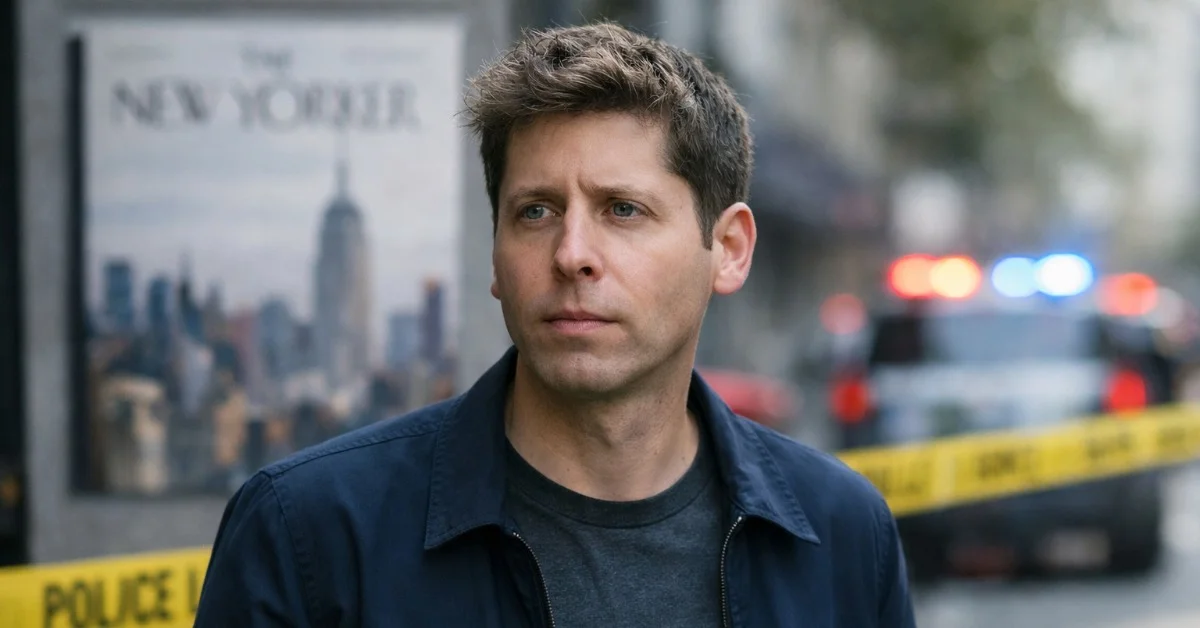
OpenAI chief executive Sam Altman has used a personal blog post to respond to a critical New Yorker profile while a separate criminal case over an attack on his San Francisco home continues to develop. The two stories overlapped in timing, but they should not be collapsed into one claim: the profile raised questions about Altman’s leadership and trustworthiness; the home-attack case is now a legal matter involving a suspect who has pleaded not guilty.
Altman’s post described the profile as unfair and argued that public narratives around artificial intelligence can become distorted at high speed. He also referred to the attack on his home, linking it to a broader point about fear and anger around AI. That passage drew attention because OpenAI is now both a powerful technology company and a lightning rod for criticism over jobs, safety, governance and concentration of power.
What Altman was responding to
The New Yorker profile, published in early April, examined Altman’s career, his removal and return at OpenAI in 2023, and questions raised by former colleagues and critics about transparency. It was not a short news item; it was a long profile built around interviews and contested interpretations of Altman’s role in the AI industry.
Altman did not answer every claim line by line in the publicly visible parts of his response. Instead, he pushed back on the overall portrait and argued that the stakes of AI make public discussion unusually volatile. That response changes the public record: the profile has not been disproved, but Altman has challenged it openly.
The attack case is now separate court news
The legal track has also moved on. AP reported in May that Daniel Alejandro Moreno-Gama, the man accused of attacking Altman’s home, pleaded not guilty to attempted murder and attempted arson charges. Earlier Reuters reporting said authorities alleged that an incendiary device was thrown at the exterior of the residence and that no injuries were reported.
The case must be described with care. Moreno-Gama is a defendant, not a convicted attacker. Prosecutors have outlined serious allegations, while his attorney has pointed to a mental health crisis and disputed the way the case has been framed. A judge has also allowed a mental health evaluation. Those details make the story more complicated than a simple “anti-AI attack” headline.
Why the story matters for OpenAI
For OpenAI, the episode lands at a difficult moment. The company is under scrutiny over safety, governance, product limits, pricing and its relationship with investors. Altman’s personal visibility makes him central to that debate, but it also makes individual incidents around him easier to overinterpret.
The strongest reading is therefore narrow and factual. Altman has answered a major profile in his own voice; the alleged attack on his home is proceeding through the courts; and both events show how emotionally charged the public debate around AI has become. They do not, on their own, settle the bigger questions about OpenAI’s governance or the social consequences of artificial intelligence.