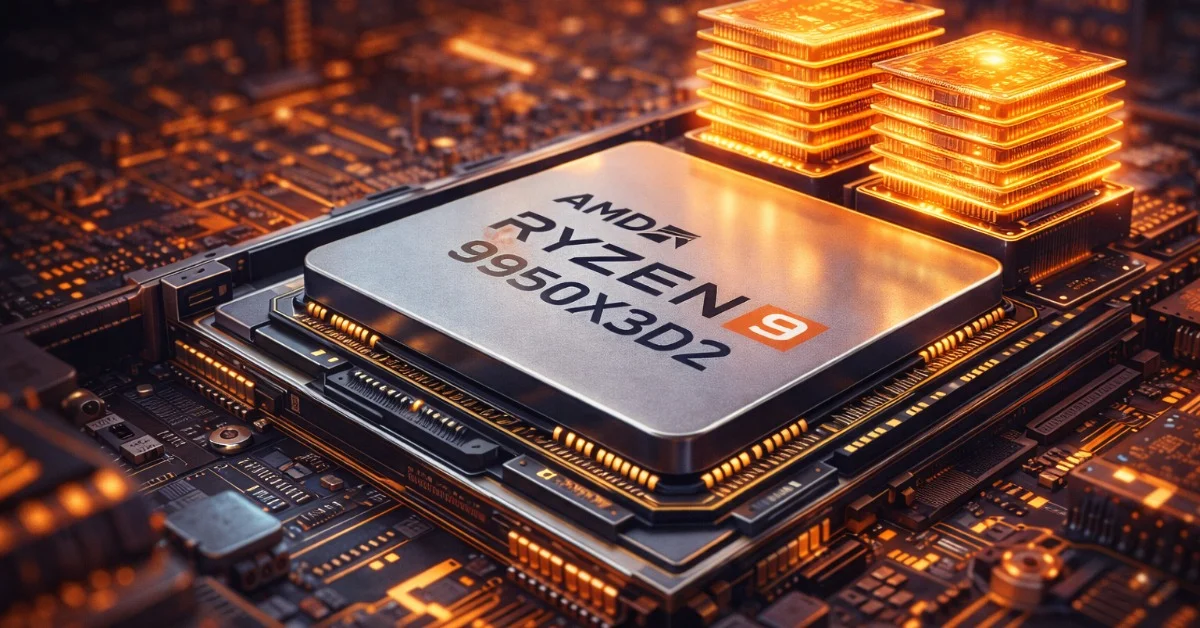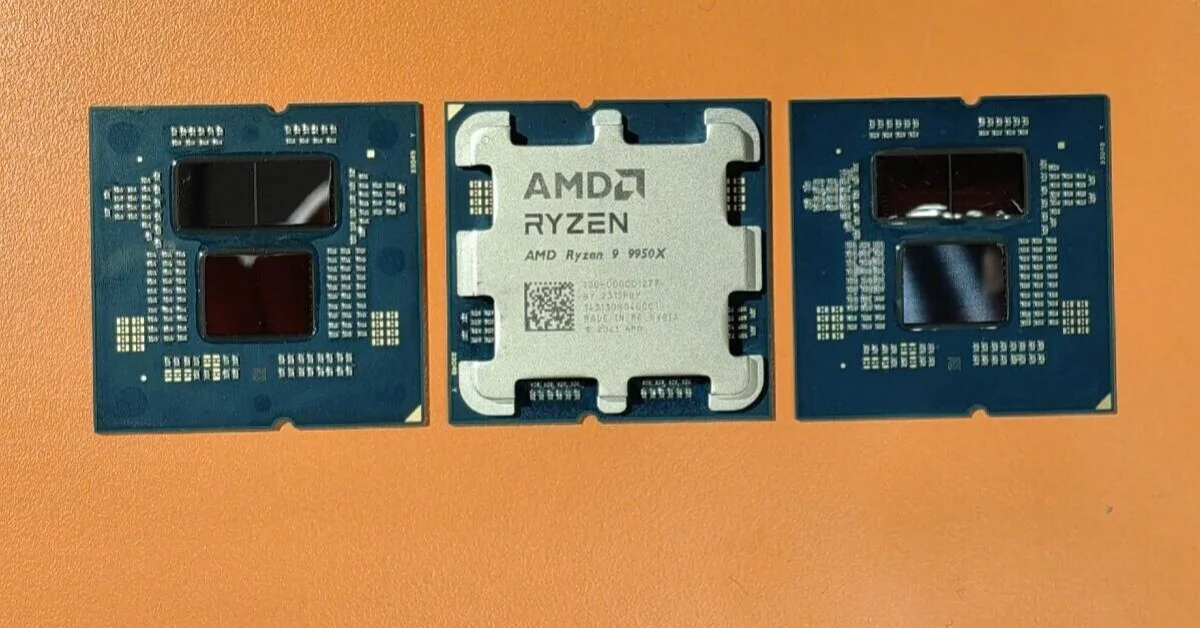
AMD’s Ryzen 9 9950X3D2 Dual Edition is real, but it should not be treated as a simple gaming upgrade with a bigger number. AMD positions the chip as the first desktop processor with dual AMD 3D V-Cache technology, aiming it at developers, creators and users with cache-sensitive workloads. The headline feature is large L3 cache across both chiplets, not a conventional clock-speed jump.
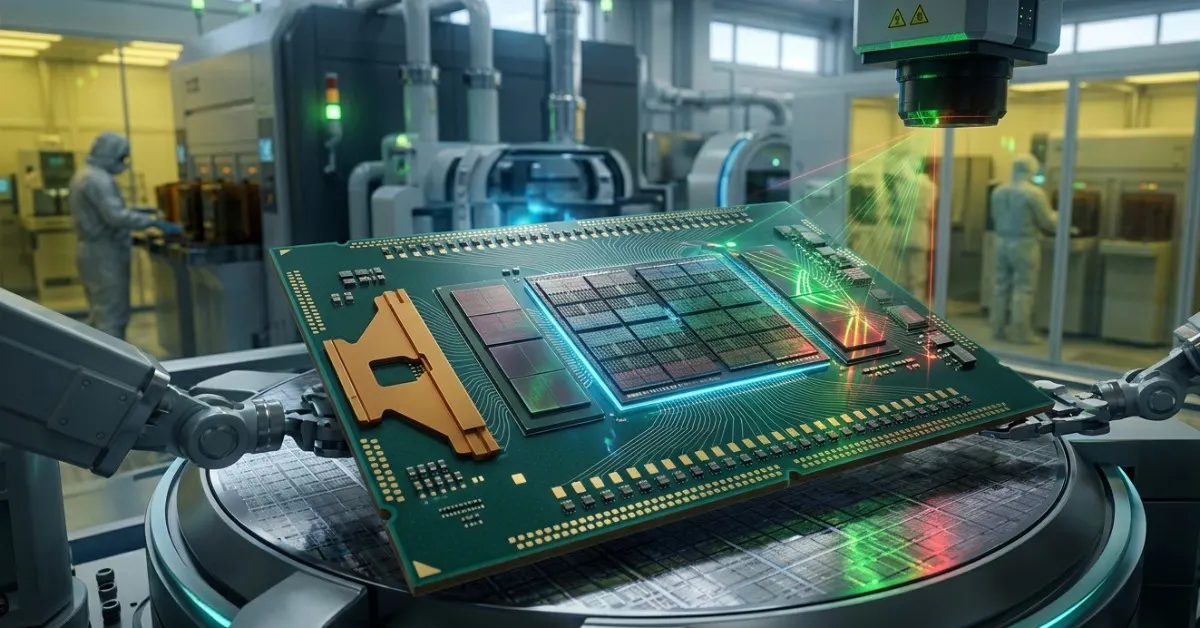
The processor builds on AMD’s Zen 5 architecture and uses the company’s 3D V-Cache strategy in a more ambitious way than earlier desktop X3D chips. AMD says the part targets demanding creation and development environments, including code builds, rendering and other workloads that can benefit from more cache. That makes the product more specialized than a typical flagship gaming CPU.
Why dual V-Cache matters
Previous high-end X3D designs often created a trade-off between a cache-heavy chiplet and a frequency-oriented chiplet. Dual V-Cache changes that balance by putting extra cache on both CCDs. In theory, that can help workloads that span cores and are sensitive to memory latency or repeated data access. The benefit is not universal, but it gives AMD a clearer workstation-adjacent pitch.
For developers, the most relevant cases are large source builds, simulation, certain compile tasks, content creation pipelines and workloads that reuse large data sets. AMD’s launch material specifically points to creator workloads such as DaVinci Resolve and Blender, as well as massive source code builds including Unreal Engine and Chromium. Those examples explain why the chip is marketed beyond gaming.
Performance gains need context
Independent reviews make the picture more measured. Puget Systems found strong performance in some creator workloads, but not every test turns extra cache into a dramatic lead. Hardwareluxx also frames the processor as a high-end and expensive part where the extra cache is useful in specific scenarios, while gaming gains may not justify the upgrade for everyone.
That distinction matters for buyers. A developer compiling large projects every day may value a few percent improvement if it saves time repeatedly. A gamer who already owns a strong X3D CPU may see less practical value, especially if the price and power draw are higher. The 9950X3D2 is therefore not a universal best choice; it is a tool for workloads that can actually use its cache structure.
Power, platform and price are part of the story
More cache and a premium design also bring trade-offs. High-end CPUs need strong cooling, a capable motherboard and enough memory bandwidth to avoid bottlenecks elsewhere. A workstation build around the 9950X3D2 should be planned as a full system, not just a processor swap.
Pricing is another consideration. AMD’s X3D line already carries a premium because it often leads in gaming or cache-sensitive tasks. A dual V-Cache model pushes that premium further. For small studios, freelancers or developers building their own machines, the value depends on how much time the chip saves in real projects, not on benchmark charts alone.
Who should care?
The Ryzen 9 9950X3D2 Dual Edition is most interesting for users who live in heavy development, rendering, simulation or mixed creator workloads and also want strong gaming performance on the same machine. It is less compelling as an impulse upgrade for users whose work is GPU-bound or whose current CPU is rarely saturated.
AMD has created a distinctive desktop part with dual 3D V-Cache, but the product is best understood as targeted rather than universal. The processor expands what an X3D chip can be used for; it does not make every older high-end CPU obsolete. Buyers should match the cache advantage to their actual workloads before paying for it.