AMD’s Ryzen 9 9950X3D2 is no longer just a future listing or pricing rumor. AMD launched the Ryzen 9 9950X3D2 Dual Edition on April 22, 2026, with a suggested e-tail price of $899 and positioning aimed at developers, creators and high-end desktop users who can make use of a larger cache footprint. Because April 22 has passed, the focus is now availability and early evaluation rather than a pending launch.
What AMD changed with the 9950X3D2
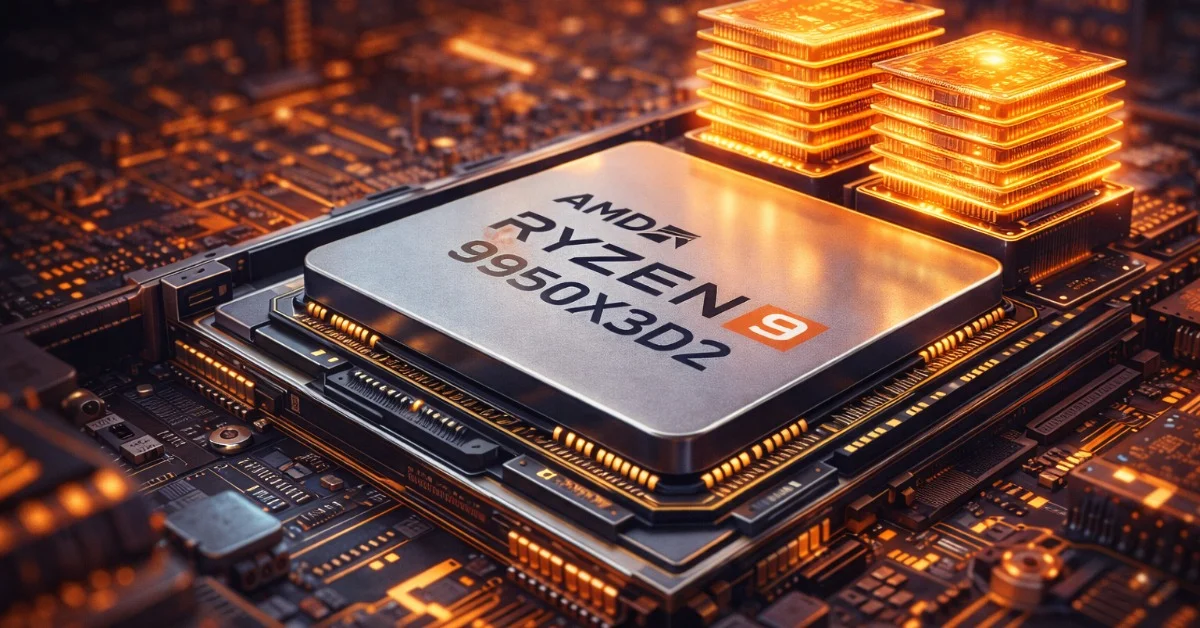
The headline feature is dual AMD 3D V-Cache. Previous 16-core X3D desktop chips placed stacked cache on one core chiplet, which could create a split between cache-heavy and frequency-focused cores. With the Ryzen 9 9950X3D2, AMD says both chiplets get 2nd Gen AMD 3D V-Cache, giving the processor 208 MB of total cache. The official specification table lists 16 cores, 32 threads, a boost clock of up to 5.6 GHz, a 4.3 GHz base clock, a 200 W TDP and the $899 SEP.
That makes the processor a niche flagship rather than a simple gaming recommendation. The extra cache is designed to keep more data closer to the CPU cores, which can help in some development, simulation, compile and content creation workloads. AMD’s launch material also ties the chip to prebuilt systems, including Alienware’s Area-51 Desktop, alongside retail availability.
The price premium is the main constraint
The $899 price puts the 9950X3D2 well above mainstream gaming CPUs and above the earlier Ryzen 9 9950X3D launch price. That premium is easier to justify for users whose work benefits from memory-sensitive throughput than for players who only want the best frame rate per dollar. Independent testing also suggests buyers should be careful: Tom’s Hardware found the chip’s gaming performance close enough to the standard 9950X3D that it should not be treated as a major gaming leap by itself.
For workstation-style users, the calculation is different. A developer compiling large codebases, a creator working in heavy render or video pipelines, or an enthusiast running memory-sensitive workloads may value the cache and core count together. For a gaming-only build, cheaper X3D parts can still be the more rational choice, especially when graphics card budget often matters more.
Who should actually consider it
The Ryzen 9 9950X3D2 is best read as AMD’s specialty desktop chip for people who already know why they need it. It keeps AM5 compatibility, but a 200 W processor also demands appropriate cooling and motherboard support. Buyers should check BIOS compatibility, power limits and cooler capacity rather than assuming it is a drop-in upgrade for every existing AM5 system.
In short, the 9950X3D2 is a real and available high-end part, not a speculative listing. Its value depends on workload. It is impressive as a dual-cache desktop design, but the $899 price means the target audience is narrower than the launch headline suggests.