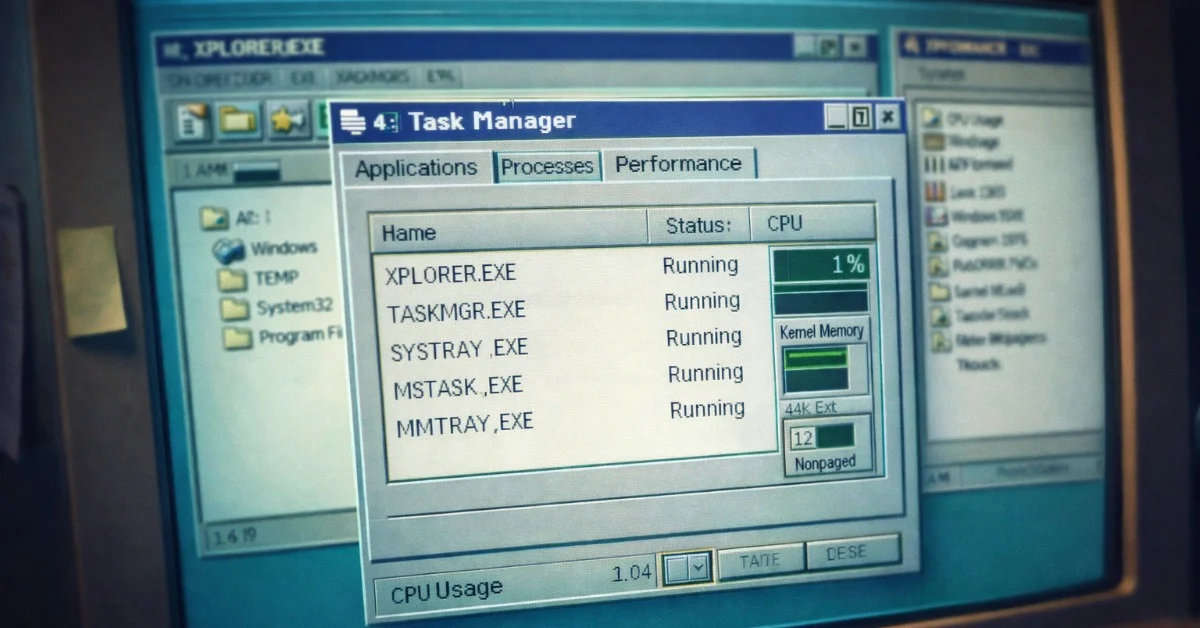
Dave Plummer, the former Microsoft engineer who created the original Windows Task Manager, has explained why the early utility was kept below roughly 80KB. The answer is less about nostalgia than engineering discipline: Task Manager had to open quickly when Windows was already under pressure, so every dependency, allocation and code path mattered. Plummer has discussed the design in a recent Dave’s Garage video and in follow-up coverage from specialist technology publications.
Why 80KB mattered on 1990s PCs
The number stands out today because modern software is often measured in hundreds of megabytes or more. In the 1990s, however, a small utility could make the difference between recovery and a hard reboot. Task Manager was supposed to appear when an application had frozen, memory was tight or the desktop had become unreliable. If the tool needed a heavy framework or a long startup path, it would fail at the exact moment users needed it most.
That constraint shaped the design. The original Task Manager needed to be small, fast and dependable. It did not have to be beautiful or broad. It had to show processes, let users inspect resource use and provide a way to end a failing application. The restraint was not a lack of ambition; it was the product requirement.
The comparison with modern software
The story resonates because many users now feel that everyday software has become heavier than the job requires. Electron apps, always-on updaters, telemetry layers and large cross-platform frameworks can make simple tools feel slow on hardware that is objectively powerful. Not every large application is wasteful, and modern software also handles accessibility, security, networking and graphics requirements that older tools did not. But Plummer’s example is a reminder that size still has consequences.
For operating-system utilities in particular, responsiveness is a feature. A task monitor, settings panel, screenshot tool or recovery utility should not feel like a full application suite. When the system is under stress, users need tools that start immediately and degrade gracefully.
Why the story still resonates
The point is not that all modern software should return to 80KB. That would be unrealistic. The useful lesson is that engineers should know which dependencies they are adding and why. If a tool’s main value is speed and reliability, adding a heavier stack can quietly undermine the product.
Task Manager’s early design is therefore more than a trivia item. It shows a style of engineering where constraints were visible and product purpose drove technical choices. Modern teams cannot copy the exact environment, but they can still copy the habit: define what must be fast, protect it from unnecessary weight and treat reliability as part of the user experience.
The story also explains why small utilities earn long-term affection. Users remember tools that work when everything else is failing. Task Manager became that kind of tool because it was available at the moment of stress, not because it had the most features. That lesson still applies to recovery tools, developer consoles and system monitors today. A utility can be modern and accessible without forgetting that its first job is to be ready immediately.