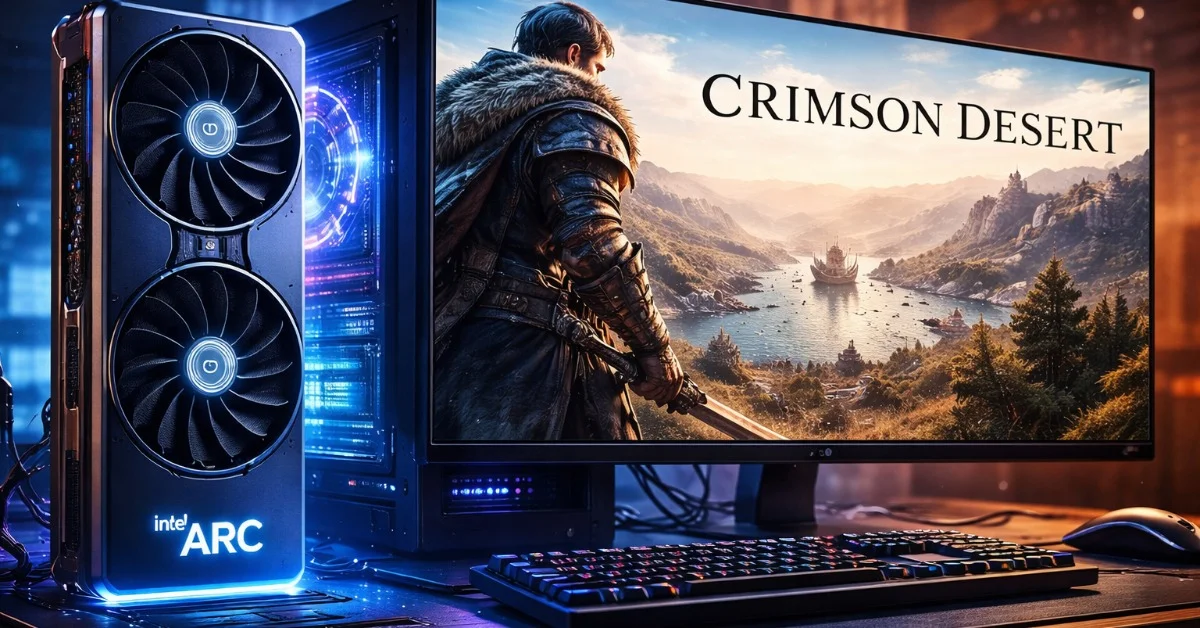
Crimson Desert is no longer a hard “do not launch” case for every Intel Arc user, but the situation is still not clean enough to call fully resolved. Intel’s 32.0.101.8629 WHQL graphics driver added Game On support for Crimson Desert across several Intel Arc configurations, and community reports soon showed the game booting on systems that previously failed outright. That is a meaningful improvement for players who bought the game on Arc hardware and were initially pushed toward refunds.
The better headline, however, is not that Crimson Desert suddenly has perfect Intel Arc support. Intel’s own release notes and Pearl Abyss’ known-issues page still describe remaining problems, including corruption during gameplay, visual artifacts and crashes tied to upscaling features. The result is a compatibility story that has moved from “blocked” to “playable for some users, unstable for others.”
What changed with Intel’s driver
Intel’s April 7 driver package, version 32.0.101.8629, lists Game On support for Crimson Desert on Intel Arc B-series and A-series graphics, as well as Intel Core Ultra systems with integrated Arc graphics. It also lists fixes for corruption across the game window and visual corruption on characters or plants, depending on the GPU family. Those notes explain why users began reporting that the game could finally start on cards such as the Arc B580 and A770.
That driver did not erase every defect. Intel’s notes still mention Crimson Desert corruption when upscaling is used on some integrated Arc configurations. Separate reporting and user accounts point to facial artifacts, terrain glitches and inconsistent performance. For players, the practical advice is simple: update the driver first, then test the game carefully before assuming it is stable enough for long sessions.
Pearl Abyss still lists Arc-specific issues
Pearl Abyss’ own known-issues page reinforces the cautious reading. The developer notes that Crimson Desert can sometimes crash on Intel Arc A770 GPUs when XeSS is used. It also says the game screen may not display properly when Intel XeSS 3.0 or XeSS Frame Generation is enabled on Intel Arc A-series graphics cards. That matters because the game’s image reconstruction and frame-generation features are central to performance on midrange hardware.
In other words, Arc owners may be able to enter the game, adjust settings and play, but they may also need to avoid certain upscaling modes. That is a very different experience from official, polished support. It is also why users should not treat early reports of “it runs now” as a guarantee for every Arc model, driver setting or scene.
Why the launch created frustration
The issue became controversial because Crimson Desert initially arrived without clear, reliable Intel Arc support. For PC players, graphics-card compatibility is not a small detail; it determines whether a purchased game works at all. Intel later indicated that it had offered help, while Pearl Abyss updated its stance and began working on compatibility. The public back-and-forth left Arc users feeling like an avoidable support gap had reached paying customers.
From a broader PC gaming perspective, the case shows how fragile support can be for smaller GPU ecosystems. Nvidia remains dominant in discrete PC gaming, AMD has a long second-place presence, and Intel Arc is still building developer relationships. A game that launches without robust Arc validation may affect a smaller share of players, but those players are often exactly the enthusiasts most likely to discuss technical problems publicly.
What Arc users should do now
Players on Intel Arc hardware should install the latest supported Intel driver, check Pearl Abyss’ known-issues page and be prepared to disable XeSS or frame-generation features if crashes or display errors appear. They should also test early enough to remain within refund windows where applicable. The situation is better than it was at launch, but not settled.
For Pearl Abyss and Intel, the next step is clear: compatibility needs to move from workaround status to predictable support. Until crashes and visual corruption are resolved across common Arc configurations, Crimson Desert on Intel Arc remains a qualified recommendation, not an all-clear.