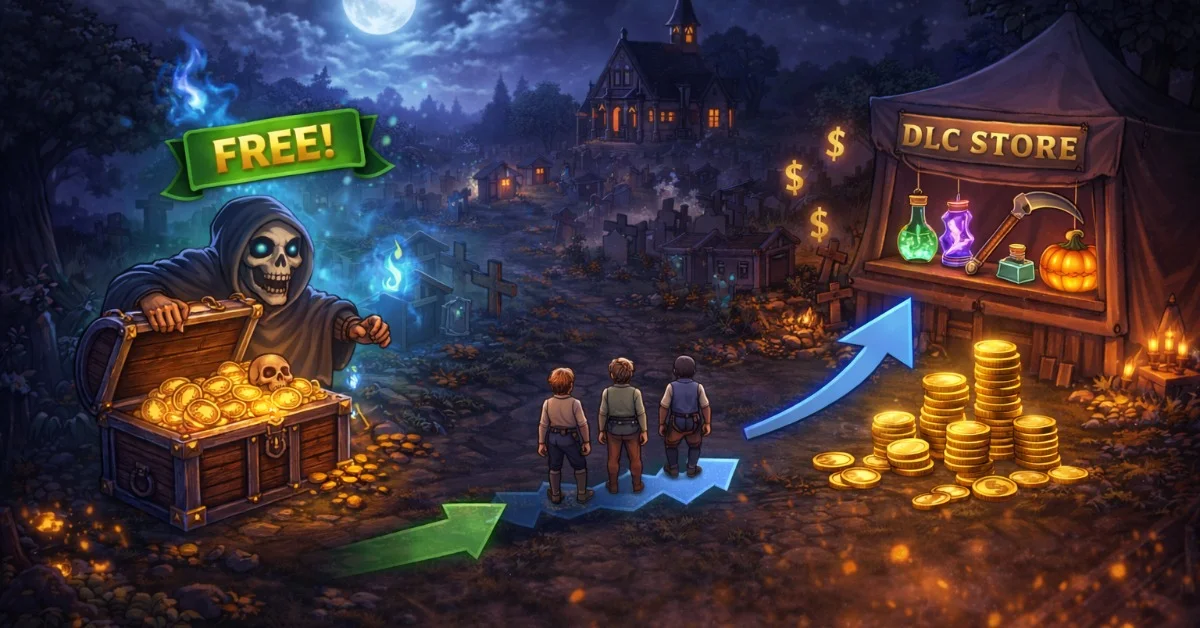
Graveyard Keeper became a useful case study in how a free promotion can still generate money when a game already has a deep DLC catalogue. Publisher tinyBuild gave the original game away on Steam to build attention for Graveyard Keeper 2, and several reports say the move produced roughly a quarter-million dollars in DLC revenue while also lifting sequel wishlists.
The numbers are best treated as a specific promotional result, not a universal rule. A free giveaway does not automatically turn into revenue. It worked here because Graveyard Keeper already had years of add-ons, an existing audience, a visible sequel announcement and a Steam campaign structured around a 100% discount.
Why the free campaign made money
PC Gamer and GamesRadar both reported that tinyBuild CEO Alex Nichiporchik said the giveaway generated almost $250,000 in DLC sales on Steam. The base game being free lowered the barrier for new players, while the DLC catalogue remained a paid upgrade path. That is a different model from simply giving a complete game away with no follow-up product or paid content attached.
The campaign also helped the sequel. PC Gamer reported that Graveyard Keeper 2 had reached about 450,000 wishlists, while GamesRadar described the sequel as moving into Steam’s top 100 most-wishlisted games after the promotion. For an indie publisher, that wishlist growth can be just as important as immediate DLC revenue because it builds a larger launch funnel.
Why a 100% Steam discount mattered
GamesRadar’s follow-up coverage focused on the difference between a full discount and a standard free weekend. According to Nichiporchik, Steam’s discount-notification behavior helped the campaign spread quickly because users are alerted to discounts, while ordinary free trials may not create the same visibility. That detail matters because the tactic depended on platform mechanics, not only generosity.
The strategy also benefited from timing. The original Graveyard Keeper had already built recognition since its 2018 release, and the sequel announcement gave returning players a reason to pay attention. Without that context, a free promotion can simply create a spike of temporary users who never buy anything else.
The campaign also shows why older indie games can gain new life when a sequel is announced. A discounted or free base game can bring dormant players back, introduce newcomers to the setting and give the publisher a reason to talk about the franchise again. In this case, the paid DLC and the sequel wishlist page turned that renewed attention into measurable business outcomes.
Not every game can copy the result
The lesson for other studios is more limited than the headline number suggests. A game with no DLC, no sequel, no strong store visibility or no clear upgrade path may not see the same return. Even games with paid DLC still need enough appeal for new players to keep playing after claiming the base game.
The Graveyard Keeper campaign worked because it connected three goals: a large influx of players for the original game, fresh revenue from discounted add-ons and a bigger audience for the sequel. That makes it a smart marketing case, but not a guaranteed formula for every indie release.