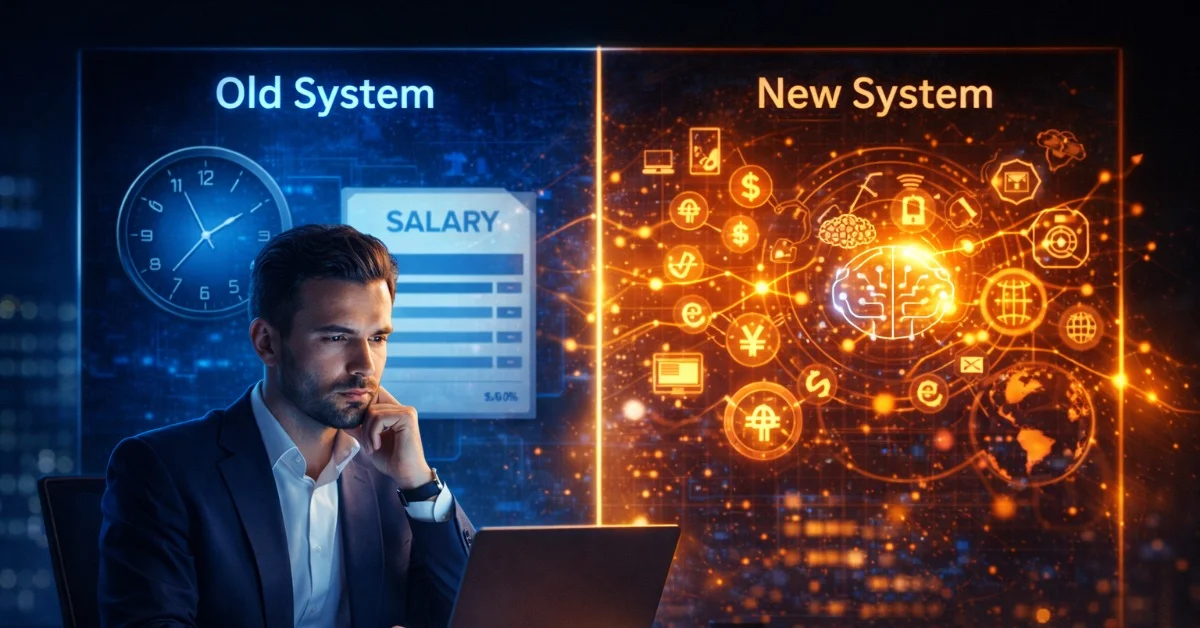
The income system is changing fastest in work that once looked secure: research, reporting, analysis, marketing, software, consulting and other jobs built around information. AI tools now compress tasks that used to take hours. Freelance platforms make specialised skills easier to sell across borders. Creator and education businesses give individuals access to audiences that once belonged mostly to media companies and employers. None of this means salaried work is disappearing, but it does mean the old link between one employer, one role and one predictable income path is weaker than it used to be.
The shift is already visible across the United States and the United Kingdom. Some workers use new tools to earn more, build side income or move toward higher-value work. Others find that the same tools make their current tasks cheaper, faster and easier to redistribute. The difference is not simply talent or work ethic. It is whether people understand what has changed, which parts of their work are becoming commoditised, and where they still have room to build leverage.
This analysis explains that change without hype or panic, using the clearest picture the current data allows.
The Old Contract
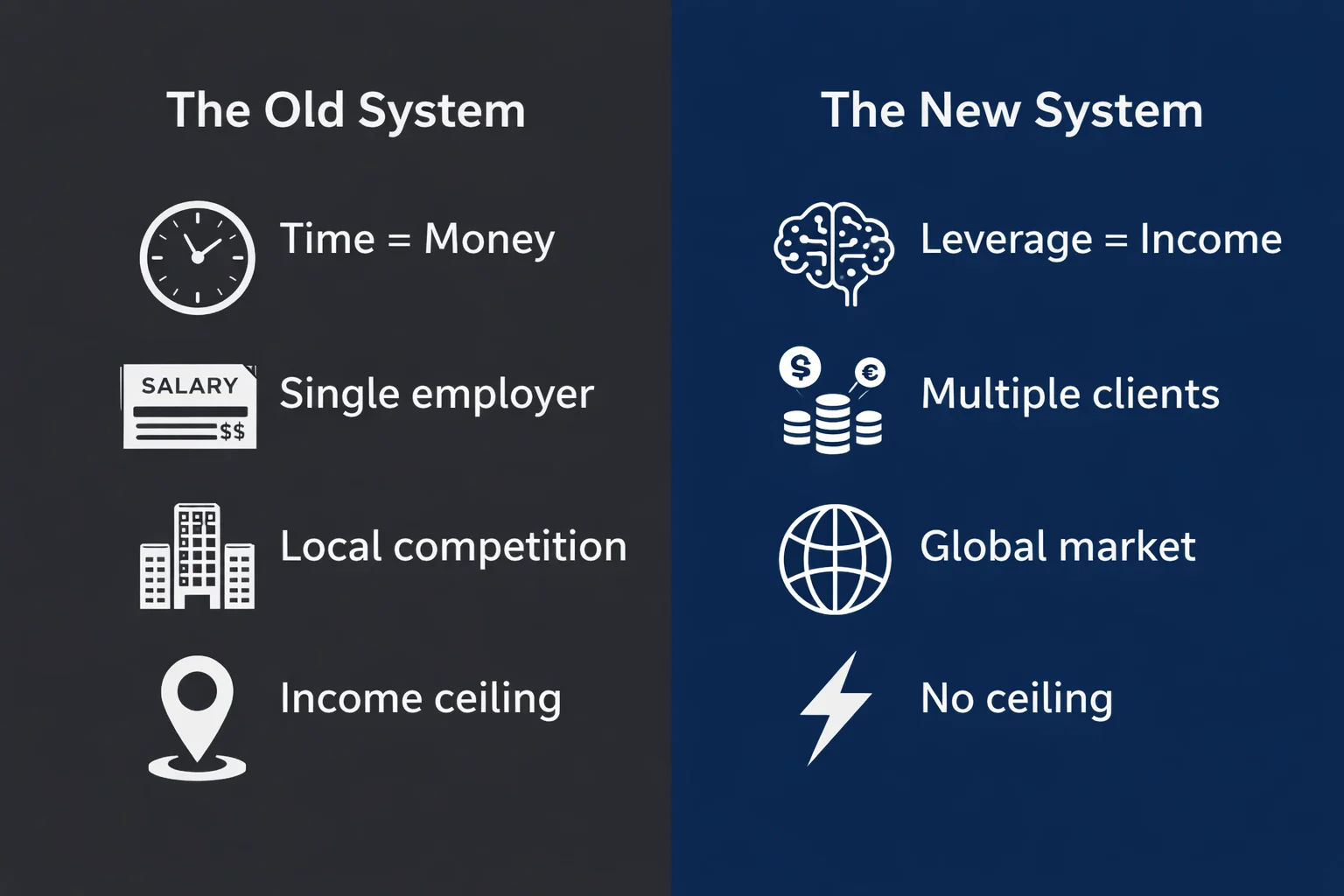
For most of the twentieth century, the employment relationship in Western economies was built on a straightforward exchange. You gave a company a defined number of hours each week; the company gave you a wage, benefits and, implicitly, security. The more specialised your skills, the more valuable your hours became. The system rewarded credentials, longevity and physical or organisational presence.
This model produced genuine prosperity for millions of people. But it contained a structural limitation that many workers never had to confront directly: income was still constrained by time. There are only so many hours in a week. No matter how skilled or productive you became, your earnings had a ceiling defined by the hours you could sell, unless you owned equity, built a business or reached a senior position with unusual leverage.
That ceiling held as long as human labour was the only viable way to complete most cognitive tasks. It began to crack when software started doing those tasks instead. It cracked further when distribution, payments and professional marketplaces made it possible for individuals to sell expertise directly across borders.
Three Forces That Changed Everything Simultaneously
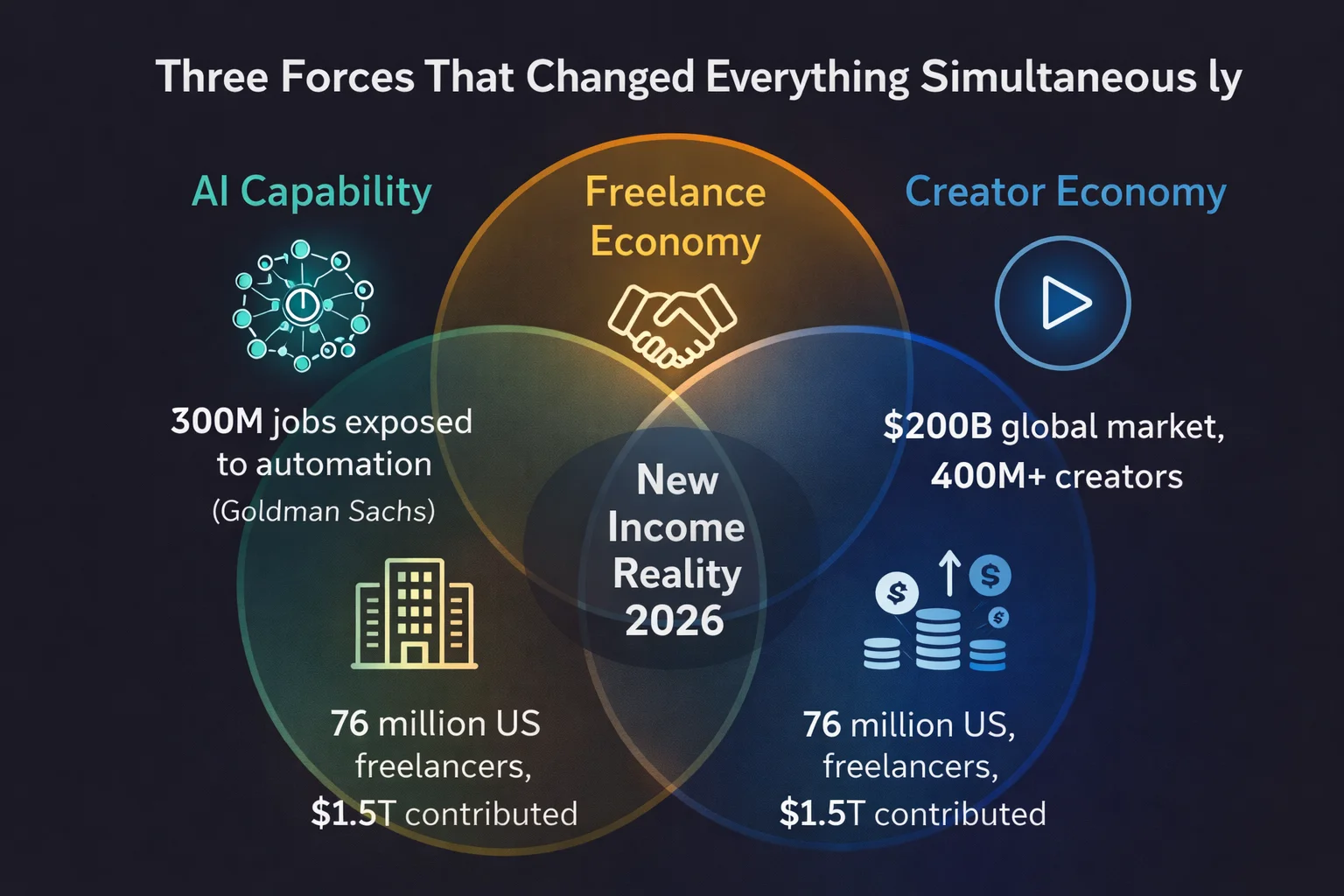
What makes 2026 different from previous technological transitions is not that one big thing happened. It is that three structural forces converged at the same time, and each amplifies the effects of the other two.
1. Artificial Intelligence Crossed a Capability Threshold
The release of GPT-3 in 2020 and the subsequent wave of large language models marked a genuine inflection point. For the first time, AI systems could produce text, code, analysis and creative work at a level that was useful in many professional contexts. By 2026, AI tools are embedded in daily workflows across finance, law, marketing, software development, medicine, media and customer operations.
The World Economic Forum’s Future of Jobs Report 2025 projected that structural changes could create 170 million new roles by 2030 while displacing 92 million, producing a net gain but requiring large movements between occupations and skill sets. Morgan Stanley’s 2026 labour-market analysis also warned against a simplistic “AI destroys all jobs” narrative: broad disruption remains limited so far, but displacement is more visible among younger workers and highly automatable roles.
The immediate effect is not always mass unemployment. Often it is redesign. Work that used to be assigned to junior analysts, paralegals, marketing assistants or entry-level developers is being absorbed by software and supervised by fewer, more experienced people. The ladder still exists, but some of its lower rungs are becoming narrower.
2. The Independent Workforce Reached Critical Mass
Independent work is no longer a fringe category. MBO Partners’ 2025 State of Independence study reported that 72.9 million Americans worked independently in some form, and that a record 5.6 million independent workers earned more than $100,000 annually. The important story is not only the number of people doing gig work. It is the professionalisation of high-skill independence.
Software developers, designers, writers, analysts, marketers, consultants and legal specialists increasingly sell services directly to clients rather than relying exclusively on a single employer. Platforms such as Upwork, Fiverr, Toptal, Deel and sector-specific marketplaces have made international discovery, contracting and payment easier than they were a decade ago. The friction has not disappeared, but it has fallen enough to change the calculation for skilled workers.
AI accelerates this shift because it lets one person produce more with fewer fixed costs. A freelancer who can combine domain expertise with automation, research tools and AI-assisted production can compete for work that previously required a small team. That does not make independent work easy, but it changes what is possible for individuals with strong positioning.
The caveat is that independence transfers responsibility back to the worker. Client acquisition, pricing, taxes, insurance, reputation and delivery quality all become part of the job. The opportunity is larger, but so is the need for commercial discipline. The people who benefit are rarely those chasing every new platform. They are the ones who turn a specific skill into a repeatable offer for a specific market.
3. The Creator Economy Normalised Digital Income
The creator economy has also moved from novelty to infrastructure. Goldman Sachs Research has projected that the creator economy could approach half a trillion dollars by 2027. The exact size of the market varies by definition, but the direction is clear: content, audience, digital products, affiliate commerce, newsletters, courses, memberships and communities have become recognised income channels rather than side curiosities.
What matters is the normalisation of earning from digital distribution. Five years ago, making a living as a YouTube creator, newsletter writer, online instructor or digital product seller still sounded unusual to many people. Today it is a recognisable career path, and in some niches a highly professional one. The tools for editing, publishing, payments, analytics, community management and fulfilment have become dramatically more accessible.
That does not mean creator income is easy or evenly distributed. Most creators earn little, and platform algorithms can change overnight. The important shift is not that everyone can become a large media business. It is that expertise, taste, trust and audience can now become economic assets for individuals in a way that is more direct than traditional employment allowed.
The Leverage Equation
These three forces share a common structural feature: they all represent forms of leverage. Leverage, in this context, means the ability to generate income that is not directly proportional to the hours you work.
A piece of software can be sold many times. A video can accumulate views for years. A newsletter can create a direct relationship with an audience. A client relationship built through a marketplace can lead to recurring work without continuous sales effort. An AI tool can multiply output without multiplying working hours. Each mechanism weakens the old time-equals-money constraint.
Business owners and investors have always understood leverage. What is new is that many forms of leverage are now accessible to individuals without large amounts of capital, employees or traditional business infrastructure. A skilled writer, developer, designer, analyst or educator with a laptop and a clear niche can build income streams that previous generations could not easily access.
The difference is compounding. A salary normally resets every month: work the hours, receive the pay, start again. A digital asset, a client base, a reputation, a useful template, a niche newsletter or a specialised service package can accumulate value over time. The first months may produce little, but the work does not disappear in the same way. That is why the new income system rewards patience and positioning as much as raw effort.
Who Is Thriving and Who Is Struggling
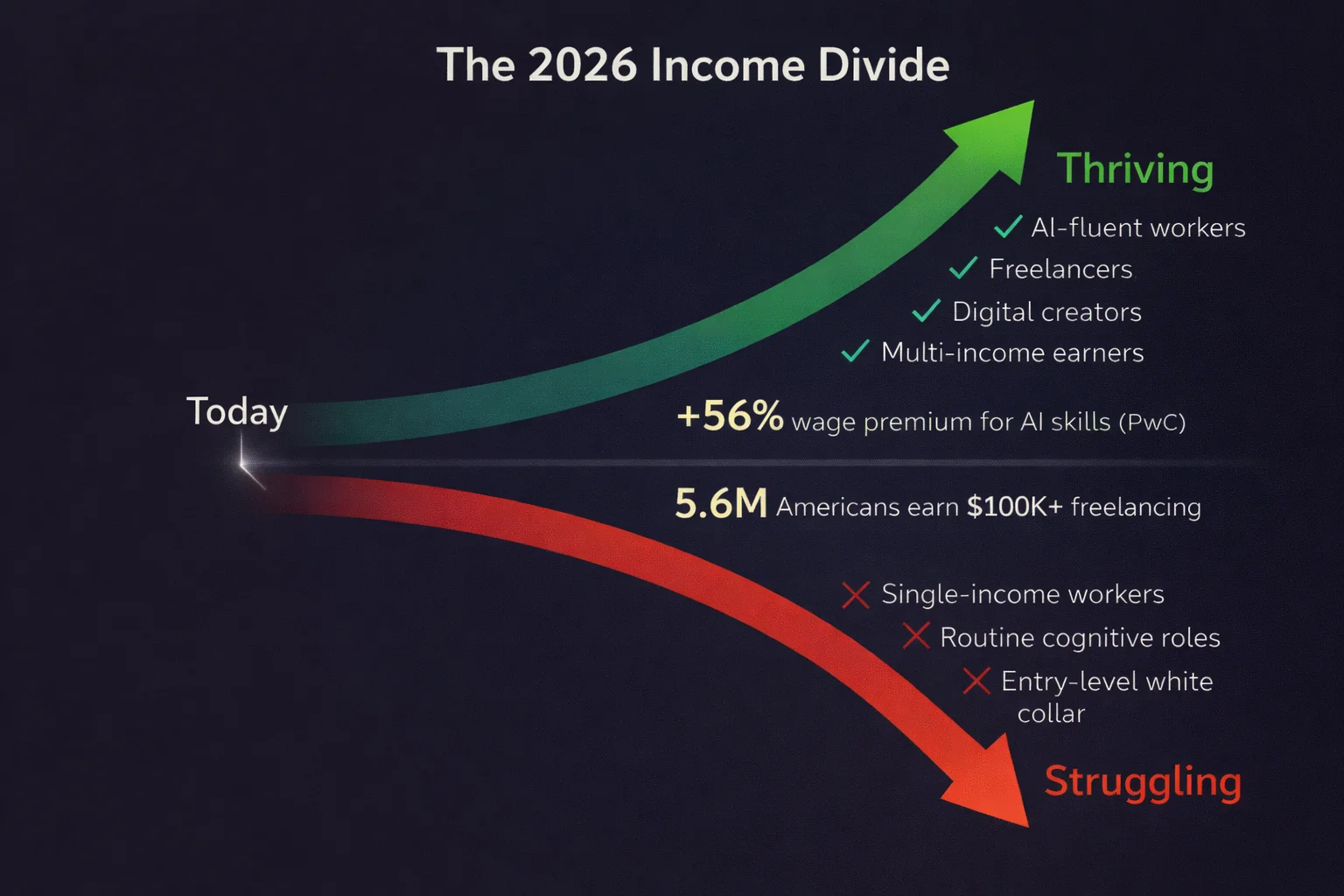
The data from 2025 and early 2026 points to divergence. Workers who build digital income models, develop AI fluency and focus on skills that compound over time are positioned differently from those whose income depends entirely on one employer and one routine function.
PwC’s 2025 AI Jobs Barometer found that workers with AI skills command a 56% wage premium compared with similar workers without those skills. Upwork has also reported higher rates for AI-related freelance work, reflecting a market where clients pay more for people who can translate new tools into useful outcomes.
At the same time, workers in routine cognitive roles face pressure. Entry-level pathways in several white-collar fields are less predictable than they used to be. This does not mean young workers have no future; it means the old sequence of degree, junior role, gradual progression and eventual stability is less reliable as a default plan.
The strongest position is not anti-employment. It is optionality. A worker with a good job, AI fluency, visible proof of skill and a small independent income stream has more negotiating power than a worker whose entire financial life depends on one employer’s next budget cycle. Optionality is the quiet advantage of the new system.
The Honest Assessment
None of this means traditional employment is over, or that everyone should immediately become a freelancer. Most economic activity still happens inside organisations, and employment offers benefits that independent work cannot fully replicate: stability, mentoring, professional community, legal protections and predictable income.
What has changed is the risk profile of relying on a single income source from a single employer. In a labour market where AI is reshaping tasks faster than many companies can explain, where entry-level hiring is becoming more selective and where the tools for building independent income are more accessible than ever, the logic of building at least one additional income stream is stronger than it used to be.
The people who will look back at 2026 as a defining professional moment are not necessarily those who quit their jobs overnight. They are the ones who assessed their position honestly, identified leverage opportunities that matched their skills and built something alongside their existing work, steadily and deliberately.
The question is not whether the system has changed. It has. The question is what you are building within it.
For specific strategies and methods: 10 Real Ways to Make Money in 2026 (A Detailed Guide)