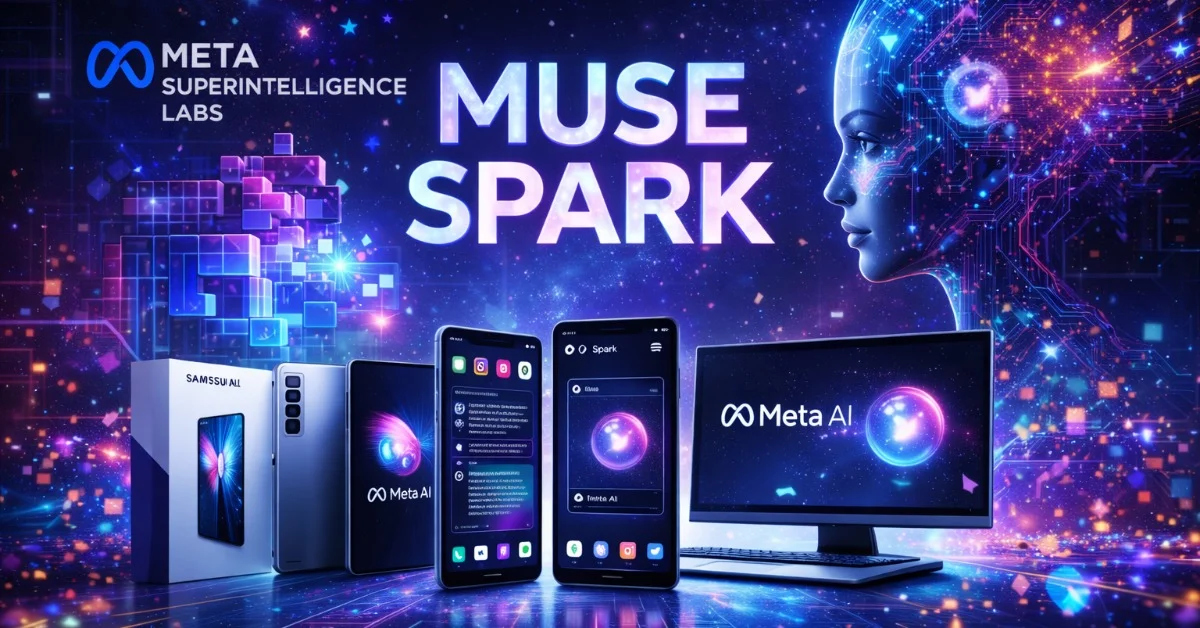
Meta has introduced Muse Spark, the first model in its new Muse family and the first public model release from Meta Superintelligence Labs. The company says the model now powers Meta AI on the Meta AI app and meta.ai, with new modes and capabilities beginning to roll out in the United States and wider deployment planned for WhatsApp, Instagram, Facebook, Messenger and Meta’s AI glasses in the coming weeks.
What Meta is claiming for Muse Spark
Meta describes Muse Spark as a multimodal reasoning model built with support for tool use, visual chain-of-thought style reasoning and multi-agent orchestration. In practical product terms, the company is using it to make Meta AI faster and more capable across text, image understanding, planning and complex question answering. Meta’s research post says Muse Spark is available through Meta AI and that a private API preview is being opened to selected users.
The model is being presented as a foundation for Meta’s next phase rather than as a final answer to the AI race. Meta says larger models are already in development and frames Muse Spark as an early result from a rebuilt AI stack. That wording matters: the company is not simply announcing another assistant feature, but trying to show that its reorganized AI division can ship a model into consumer products.
How it changes Meta AI
On the product side, Meta says the upgraded assistant can switch between faster responses and more reasoning-heavy tasks. The company also highlights multi-agent behavior, where several subtasks can be handled in parallel before a combined answer is returned. Meta’s examples include trip planning, multimodal image interpretation, shopping-related recommendations and visual coding tasks that can generate small websites or games from a prompt.
The rollout is also strategic because Meta can place the same assistant across several high-traffic surfaces. A model that starts in the Meta AI app and website can later appear inside WhatsApp chats, Instagram discovery, Facebook, Messenger and AI glasses. That gives Meta a distribution advantage few AI companies can match, but it also raises the stakes for accuracy, user controls and privacy explanations.
Why the launch matters
Muse Spark arrives after a period in which Meta faced pressure to prove that its AI spending and reorganization would produce visible products. The announcement positions the model as smaller and faster by design, while still capable of handling reasoning and multimodal tasks. Independent testing will be needed before outside observers can judge how it compares with rivals from OpenAI, Google, Anthropic and others.
For users, the near-term change is not a new standalone gadget but a more capable Meta AI layer inside services they may already use. For the industry, the more important signal is that Meta is tying model development directly to its consumer ecosystem. If Muse Spark performs reliably at scale, it could make Meta AI feel less like a separate chatbot and more like an embedded assistant across the company’s apps. If it disappoints, the launch will sharpen questions about how quickly Meta can turn heavy AI investment into products people want to use every day.