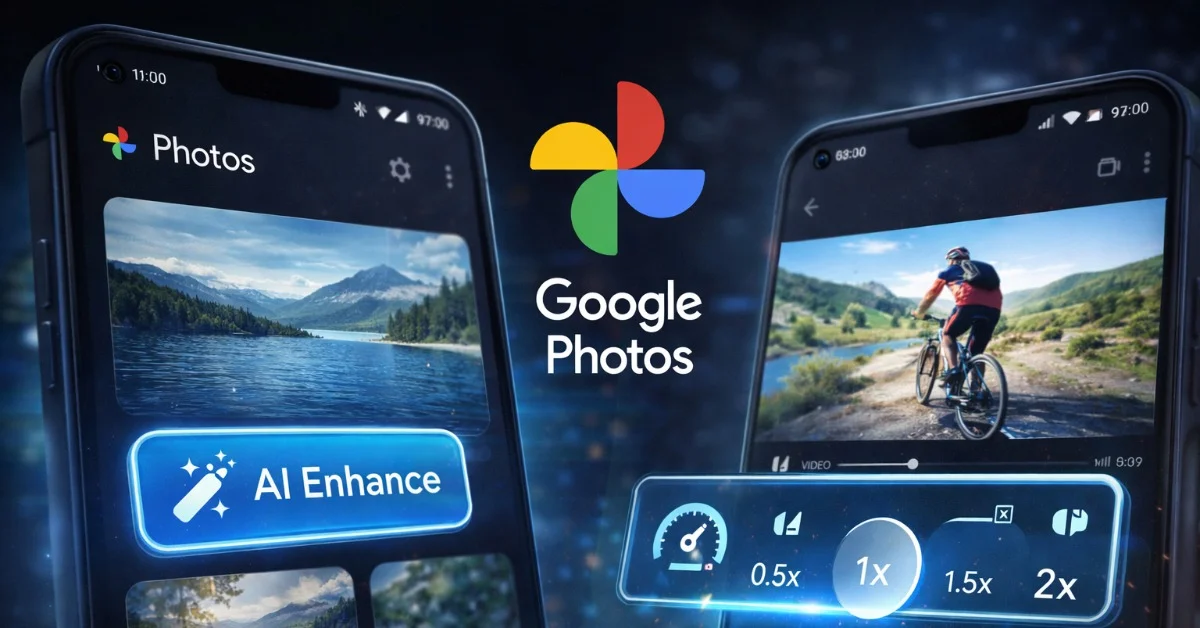
Google Photos is rolling out two useful Android updates: an AI Enhance button for one-tap photo improvements and video playback speed controls inside the viewer. The changes were reported on April 6 and 7, 2026, after Google Photos posted about AI Enhance and Google’s support materials confirmed speed controls for Android. The update is not a full redesign, but it addresses two everyday editing gaps.
What AI Enhance does
AI Enhance is meant to give users a quick way to improve a photo without adjusting several manual sliders. According to 9to5Google’s coverage of the Google Photos announcement, the button balances light and color with a tap. It sits in the broader trend of Google packaging machine-learning edits as simple, user-facing controls rather than asking casual users to understand exposure, contrast, saturation and tone curves.
The important caveat is that output can vary by device and photo. AI Enhance should be described as a quick improvement tool, not a guarantee that every image will look better. For some photos, especially those with tricky lighting or unusual color balance, manual editing may still give better control. Still, for users who mainly want a fast fix before sharing a picture, the button makes sense.
Video speed controls finally arrive
The second update is more basic but arguably just as useful. Google Photos now lets Android users change video playback speed directly in the app. Android Authority reports that users can choose among 0.25x, 0.5x, 1x, 1.5x and 2x. That means users can slow down sports clips, skim long recordings or review a moment without exporting the video to another player.
This is different from editing a video and saving a new copy at a changed speed. Playback speed controls are about viewing. The user can watch faster or slower without necessarily altering the file. For a photo and video library app, that is a practical quality-of-life feature that should have arrived earlier.
Rollout and platform limits
The rollout is focused on Android. 9to5Google reported AI Enhance as available to Android users worldwide, while video playback speed controls appeared to be rolling out more gradually. Google has not given the same clear timeline for iOS or web availability in the reports reviewed for this update. As usual with Google Photos, some users may see the feature before others depending on app version, server-side rollout and device support.
The update also shows how Google Photos is becoming more than a backup app. It is increasingly a lightweight editing and review workspace: one-tap AI fixes for photos, playback controls for videos, search features, albums and cloud storage in the same product. These additions are not flashy compared with generative AI tools, but they solve common user problems. That is why they may matter more in daily use than a bigger, less frequent feature launch.