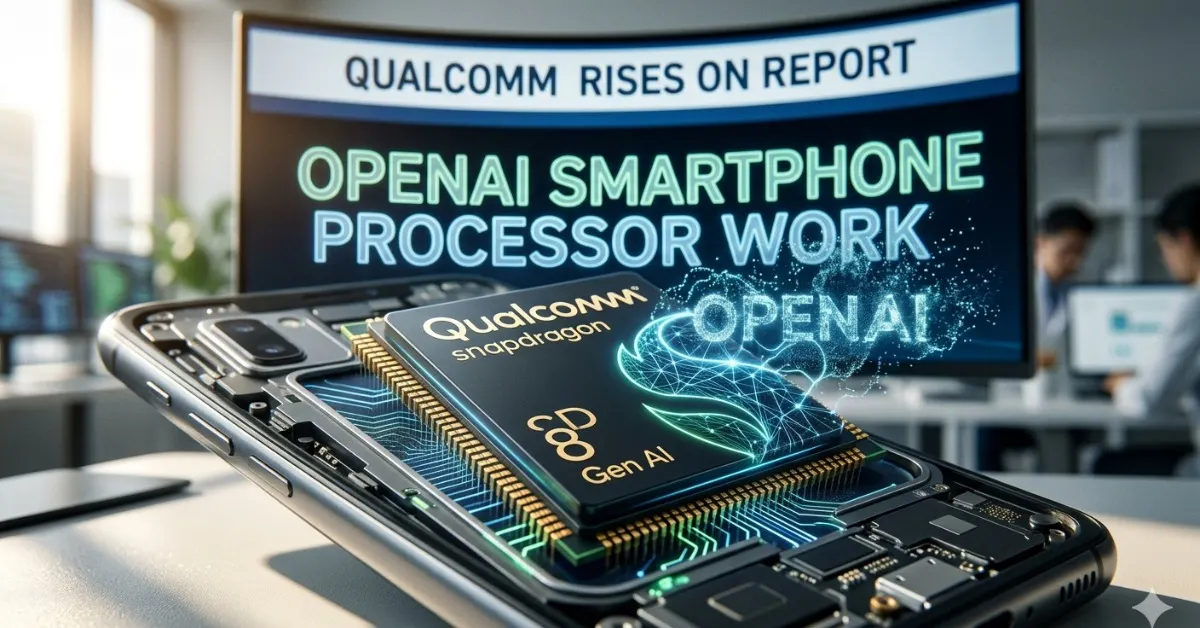
Qualcomm shares moved sharply after a report tied the chipmaker to OpenAI's possible consumer hardware plans. The report, first attributed to TF International Securities analyst Ming-Chi Kuo and carried by Reuters, said OpenAI was working with Qualcomm and MediaTek on smartphone processors for a potential AI-first device. The important caveat is just as large as the headline: none of the named companies publicly confirmed the project.
A Report, Not a Confirmed Product
According to the Reuters report, Qualcomm and MediaTek are described as processor co-development partners, while Luxshare is said to be involved in system design and manufacturing. Kuo placed possible mass production in 2028. That timeline, if accurate, would put the work in an early supply-chain phase rather than near a consumer launch.
That distinction keeps the story grounded. A processor effort would not prove that OpenAI is building a conventional smartphone, but it would suggest that the company is exploring hardware architecture seriously enough to involve mobile-silicon suppliers. For Qualcomm, even the possibility of a role in an OpenAI device was enough to catch market attention because it would connect the company to a new AI hardware cycle.
OpenAI's Hardware Question
OpenAI's hardware ambitions have been discussed for some time, especially after the company brought in design talent linked to Jony Ive's hardware venture. Previous reporting, however, has also suggested that the device might not be a normal smartphone. That leaves a tension at the center of the Qualcomm story: the supply chain may look phone-like even if the final product category remains unsettled.
The smartphone market is difficult to enter. Apple and Samsung dominate global distribution, software ecosystems, carrier relationships and consumer habits. Any OpenAI device would need more than a strong assistant; it would need battery life, cameras, app compatibility, privacy controls, retail support and a reason for people to carry another piece of hardware.
That is why the processor angle is worth watching even without a confirmed phone. Silicon decisions happen years before a product reaches shelves. If OpenAI is testing mobile processors now, the company may be exploring how much AI work can run locally, what sensors a device needs and how tightly hardware should be designed around agents instead of traditional apps.
Why Qualcomm Reacted
For Qualcomm, the report matters because mobile processors remain a core business while AI workloads are moving onto devices. If AI agents become more useful when they can process context locally, handset silicon becomes more strategically important. That is why an unconfirmed OpenAI link can move sentiment even before revenue appears.
The safest conclusion is restrained: Qualcomm may benefit if OpenAI moves deeper into mobile hardware, but the current story is still a market signal built on analyst reporting. Until OpenAI, Qualcomm, MediaTek or Luxshare confirms the project, the form factor, launch timing and commercial impact should all be treated as open questions.