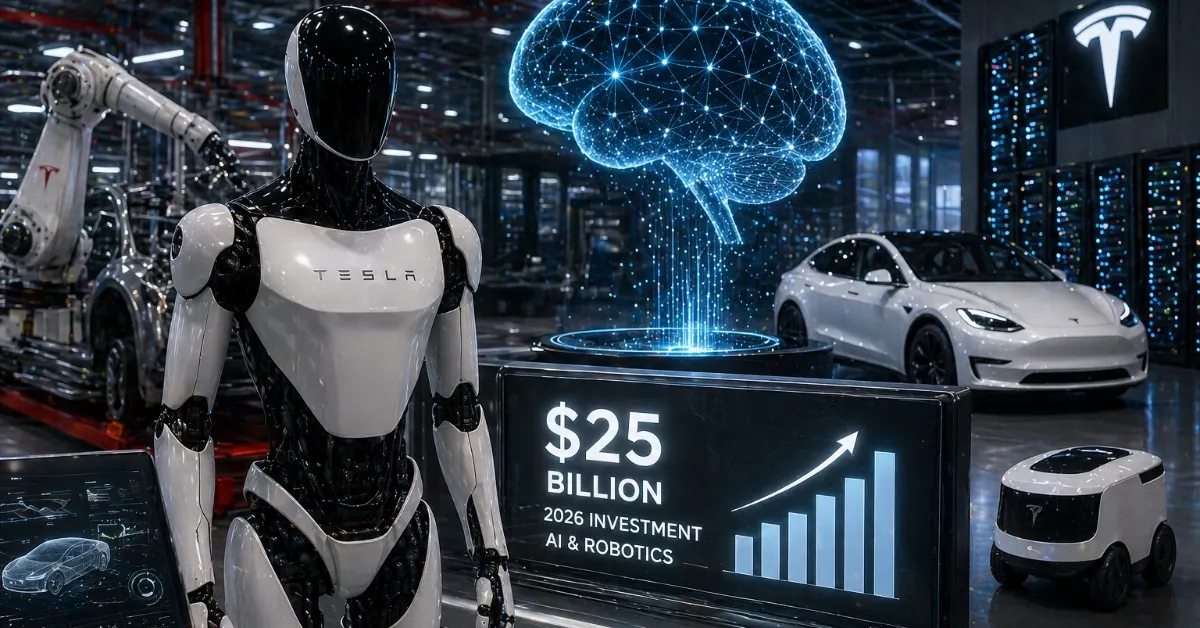
Tesla's 2026 spending plan has become one of the clearest signals that the company wants investors to judge it as an AI, robotics and autonomy business, not only as an electric-vehicle maker. After releasing first-quarter results on April 22, Tesla pointed investors to a much larger capital-expenditure year, with reporting from the earnings call putting the 2026 plan at about $25 billion.
What the $25 Billion Plan Covers
The spending increase is not framed as a normal factory-refresh cycle. Tesla is putting more capital behind AI training infrastructure, chip work, robotaxi operations, manufacturing expansion and the groundwork for Optimus humanoid robots. That mix explains why the number is being watched closely: the company is trying to fund several long-term bets at once while its core car business faces tougher competition and pricing pressure.
TechCrunch reported that Tesla had previously guided to more than $20 billion in 2026 capital expenditures, so the new figure represents a meaningful step-up rather than a small adjustment. The report also notes that Tesla's recent annual capex was much lower, making the new plan roughly three times the 2025 level.
It is also useful to separate capital expenditure from operating expense. Capex builds factories, equipment, data-center capacity and production capability, but it does not automatically create near-term revenue. That is why the timing of each project now matters: spending can be justified if robotaxi, Optimus and AI infrastructure milestones arrive, but the same spending becomes harder to defend if those projects slip.
The Cash-Flow Trade-Off
The financial risk is just as important as the ambition. Tesla ended the first quarter with a large cash position, but management warned that the heavier investment cycle would weigh on free cash flow later in the year. That matters because projects such as robotaxis and humanoid robots require long development timelines before they can produce reliable revenue at scale.
For investors, the question is not whether AI and robotics are attractive markets. The question is whether Tesla can convert spending into products that ship, operate safely and generate margin. Robotaxi services require regulatory clearance, mapping, fleet operations and public trust. Optimus requires manufacturing maturity, useful real-world capability and a clear customer base. Those are different challenges from selling another vehicle model.
Why It Matters Beyond Tesla
Tesla is not alone in raising infrastructure spending for AI. Big technology companies are also increasing budgets for compute, chips and data centers. The difference is that Tesla's AI story is tied to physical systems: vehicles, factories, robots and energy infrastructure. That makes the payoff potentially large, but it also adds execution risk because hardware timelines are less forgiving than software rollouts.
The cleaner reading is that Tesla has chosen a more expensive 2026 in exchange for a shot at a broader business model. The company can afford the push for now, but the plan will be judged by milestones rather than headlines: robotaxi expansion, Optimus progress, AI infrastructure efficiency and whether the automotive business can keep funding the transition without deeper margin damage.