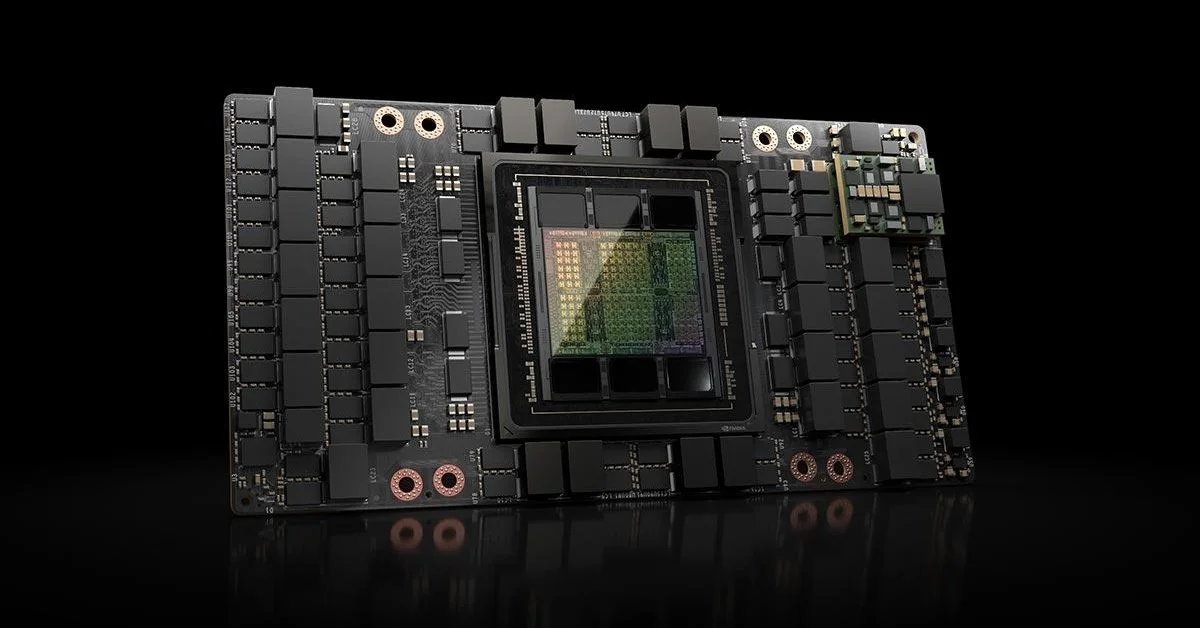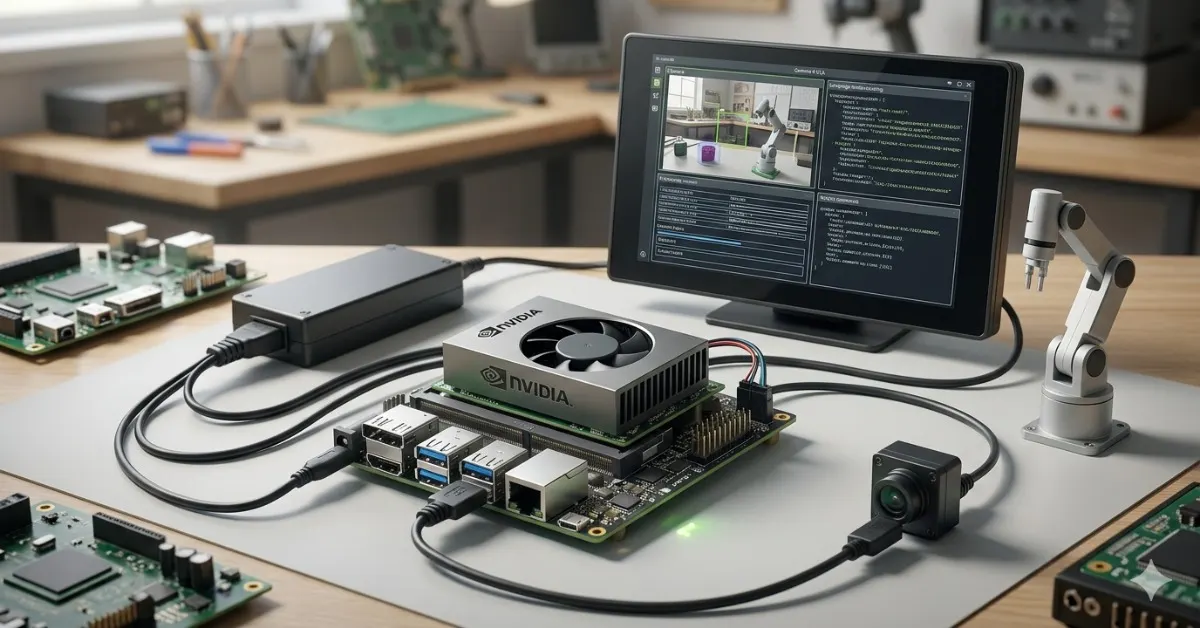
A new Gemma 4 demo is less interesting as a benchmark than as a sign of where edge AI is going. The setup, published through a NVIDIA Hugging Face community article, runs Google’s Gemma 4 on a Jetson Orin Nano Super with 8 GB of memory and turns the board into a small voice-vision-action assistant. The user speaks, speech is transcribed locally, Gemma reasons over the request, decides whether it needs a webcam frame, and then answers through text-to-speech.
The important part is not just that it runs locally
Local inference on Jetson hardware is no longer a novelty by itself. The more useful part of this demonstration is the decision loop. Instead of forcing the camera to capture an image for every request, or waiting for a rigid command such as “look at the camera,” the script exposes a visual tool and lets the model decide when to call it. In practical terms, the assistant can answer a normal question without wasting visual tokens, but it can also open the webcam when the user’s prompt depends on the scene in front of the device.
That matters for robotics, retail devices, industrial inspection and smart machines. A camera that is always on creates cost, latency and privacy concerns. A camera that only wakes when the model has a reason to inspect the environment is closer to how an embodied assistant should behave. The demo is still a developer project, not a polished consumer product, but it shows why multimodal models with tool-calling support are moving from cloud demos into small, local devices.
How the Jetson pipeline works
The public tutorial describes a stack built around Parakeet speech-to-text, Gemma 4 served through llama.cpp, optional webcam capture and Kokoro text-to-speech. The hardware list is intentionally modest: Jetson Orin Nano Super 8 GB, webcam, USB speaker, microphone and keyboard. That does not mean every model variant or every workload will fit comfortably on the board. Memory management, quantized model files, CUDA support and runtime choice still matter.
NVIDIA’s own developer material frames Gemma 4 as suitable for edge and on-device use through Jetson, with llama.cpp and vLLM routes available depending on hardware and model size. Jetson AI Lab’s documentation also separates what is realistic on Orin Nano from what belongs on larger Orin or Thor systems. This distinction matters because a tiny board is not suddenly replacing a datacenter GPU. The real shift is that smaller multimodal models are becoming capable enough for useful local loops.
Why Gemma 4 fits this kind of experiment
Google introduced Gemma 4 as an open-weight model family built for multimodal reasoning, agentic workflows and broader device coverage. That combination is what makes the Jetson demo credible. Text-only local assistants can already be useful, but they struggle when the user’s request depends on the physical world. Vision adds context; tool calling adds control; local execution reduces dependency on a cloud connection.
The trade-offs remain real. An 8 GB edge board forces compromises around model size, context length, speed and concurrency. A proof-of-concept that answers one user in a lab is not the same as a production robot or a fleet of industrial devices. Developers still need to measure latency, thermal behavior, memory pressure and failure cases. They also need to make clear when the system is capturing images and how those frames are stored or discarded.
The bigger signal for edge AI
The best reading of this demo is cautious optimism. It is not a consumer launch, and it should not be presented as a finished “local robot brain.” But it shows a useful pattern: small multimodal models, running near the sensor, deciding when to act rather than passively waiting for hand-coded triggers. That is exactly the direction many edge deployments need to move in.
If the next wave of local AI is going to matter beyond hobby projects, it has to combine three things: reliable perception, constrained but useful reasoning, and predictable behavior on modest hardware. Gemma 4 on Jetson Orin Nano does not solve all of that. It does, however, give developers a concrete starting point for testing those ideas without sending every prompt, image and voice request to the cloud.