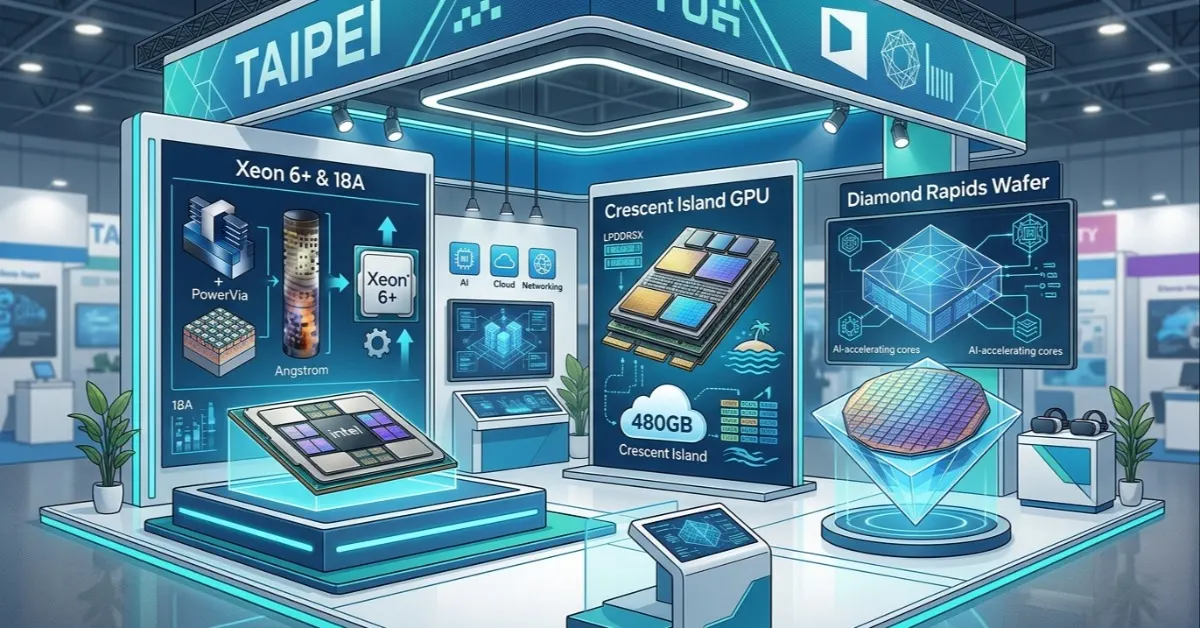
Intel used Computex 2026 to make a narrower but clearer argument about its role in AI infrastructure. CEO Lip-Bu Tan did not frame the keynote as a single-chip spectacle. Instead, Intel tied Xeon 6+, rackscale inference systems, Crescent Island and Diamond Rapids into one message: as AI moves from training into agentic and production workloads, the data center needs more than GPUs.
Xeon 6+ puts 18A into the data center
The most concrete product in the keynote was Xeon 6+, the Clearwater Forest server processor family. Intel says the chips are built on Intel 18A, with up to 288 efficiency cores and 576 MB of L3 cache. The company is positioning the line for dense, scale-out workloads where power per rack, predictable latency and orchestration matter as much as peak benchmark numbers.
That framing is important. Intel is not claiming that CPUs replace accelerators in every AI workload. Its case is that agentic AI creates more coordination, retrieval, tool use and data movement around the model. Those tasks can pull the CPU back toward the center of the rack, especially when applications need to run many concurrent agents rather than one large training job.
Crescent Island and Diamond Rapids widen the roadmap
Intel also pointed to Crescent Island, a next-generation data center GPU for inference. The notable detail is memory capacity: coverage from Computex describes configurations with up to 480 GB of local memory, using LPDDR5X rather than expensive HBM. That choice suggests Intel is aiming at a different price and capacity point than the most bandwidth-heavy training accelerators.
Diamond Rapids, meanwhile, remains the next big Xeon step for higher-performance server workloads. The message around the 2027 part was not a full launch. It was a roadmap signal: Intel wants customers to see Clearwater Forest, Crescent Island and Diamond Rapids as connected parts of a broader data center recovery plan, not isolated announcements.
The limits of Intel’s claim
The Computex pitch is stronger when kept within its limits. Intel’s own materials and independent coverage describe benchmark claims for Xeon 6+, including performance-per-thread and efficiency comparisons. Those figures are useful context, but they are still vendor-controlled results. Real buying decisions will depend on independent testing, software support, power behavior at high utilization and how quickly OEM systems become available.
The same caution applies to Crescent Island. Large local memory is attractive for inference, but the absence of HBM changes the trade-off between capacity, bandwidth, cost and power. Whether that balance works will depend on the models and deployments Intel and its partners can actually serve.
Why the story matters
Intel’s Computex 2026 story is not that the company suddenly solved AI infrastructure. It is that Intel is trying to turn its remaining strengths — x86 server footprint, process technology, packaging, Ethernet and systems partnerships — into a credible inference-era platform.
For customers, the practical question is whether that platform can reduce cost and complexity without locking workloads into narrow hardware assumptions. For Intel, the question is even sharper: it needs Xeon 6+ to prove 18A in the data center, Crescent Island to show a viable inference GPU path, and Diamond Rapids to restore confidence in the next performance Xeon generation. The keynote gave Intel a coherent story. The market will now ask for shipped systems, independent numbers and software maturity.