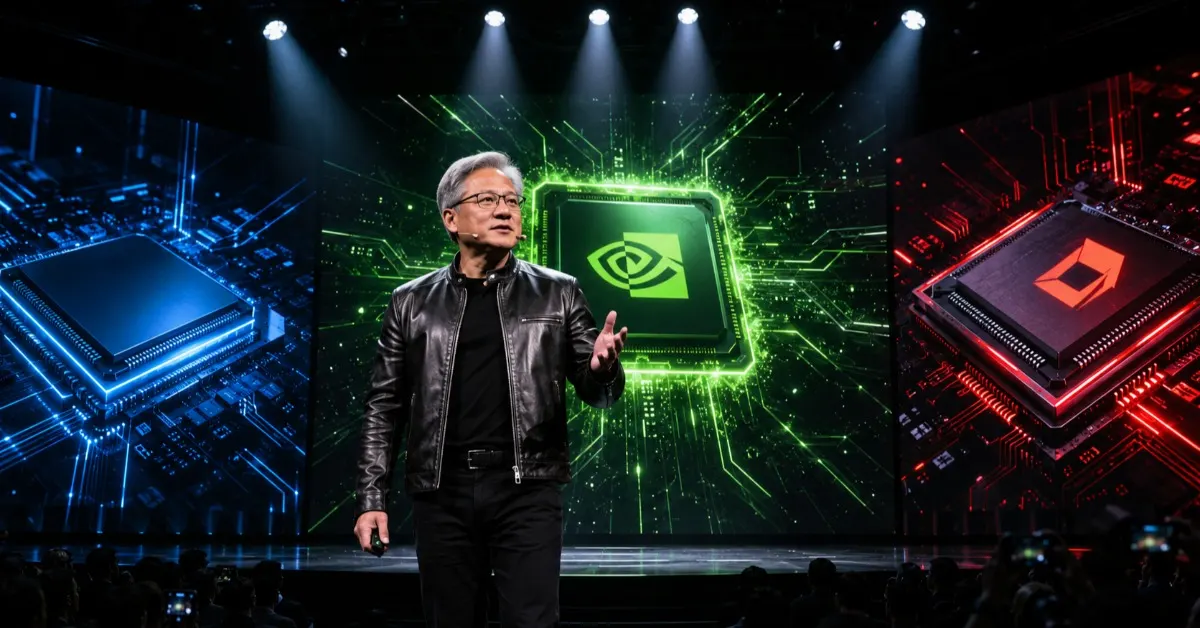
NVIDIA reported first-quarter fiscal 2027 results on May 20, 2026, with revenue of $81.6 billion, up 85 percent from a year earlier and 20 percent from the previous quarter. The data center business again carried the story: revenue in that segment reached $75.2 billion, up 92 percent year over year and 21 percent sequentially. The result confirms that demand for AI infrastructure remains the company’s main growth engine, but it also shows how dependent NVIDIA has become on data center spending.
Why the Q2 guide mattered more than the beat
The number markets watched most closely was not only the quarter just reported. NVIDIA guided second-quarter fiscal 2027 revenue to $91.0 billion, plus or minus two percent, above the average analyst estimate cited by market reports. That outlook matters because investors are trying to judge whether the AI infrastructure cycle is still accelerating or simply holding at a very high level.
NVIDIA also said the outlook does not assume any data center compute revenue from China, a reminder that export controls remain a material constraint for advanced AI chips. CEO Jensen Huang described the buildout of AI factories as the largest infrastructure expansion in human history, language that captures the scale of demand but should still be read against the political limits around China and the concentration of spending among large cloud providers.
Data center, sovereign AI and Blackwell
The earnings release and call point to three themes beyond the headline revenue number. First, data center demand is still broadening from hyperscalers to enterprises and governments. Second, sovereign AI remains a meaningful growth category, as governments build domestic AI capacity for security, language, public services and research. Third, the Blackwell platform ramp is now central to the next stage of NVIDIA’s growth.
NVIDIA has also been discussing Vera Rubin samples and early customer deployments, including customers such as Anthropic, OpenAI, SpaceXAI and Oracle. That does not mean every customer is already generating material revenue from the platform. It does show that the company is moving from today’s Blackwell cycle toward the next CPU-GPU platform transition, where orchestration, memory bandwidth and system-level efficiency matter as much as raw accelerator supply.
Buyback, dividend and market reaction
The board authorized an additional $80 billion in share repurchases and raised the quarterly cash dividend from $0.01 to $0.25 per share. Those moves signal confidence in free cash flow, but they also underline how unusually profitable the AI chip cycle has become. NVIDIA is no longer being valued like a cyclical semiconductor supplier; investors are treating it as the core infrastructure company behind the current AI buildout.
The muted stock reaction after the report was therefore not a sign that the numbers were weak. It was a sign that expectations are unusually high. When revenue can rise 85 percent year over year and still produce only a limited market response, the question becomes less about whether NVIDIA is growing and more about how long the capital expenditure wave can keep expanding.
The more useful reading is this: NVIDIA’s Q1 FY27 report strengthens the case that AI infrastructure spending remains robust, while the Q2 guide suggests the company still sees demand ahead of supply. The risks have not disappeared. China restrictions, customer concentration, margin normalization and the pace of future data center spending will define the next phase. For now, though, the quarter keeps NVIDIA at the center of the AI hardware economy.